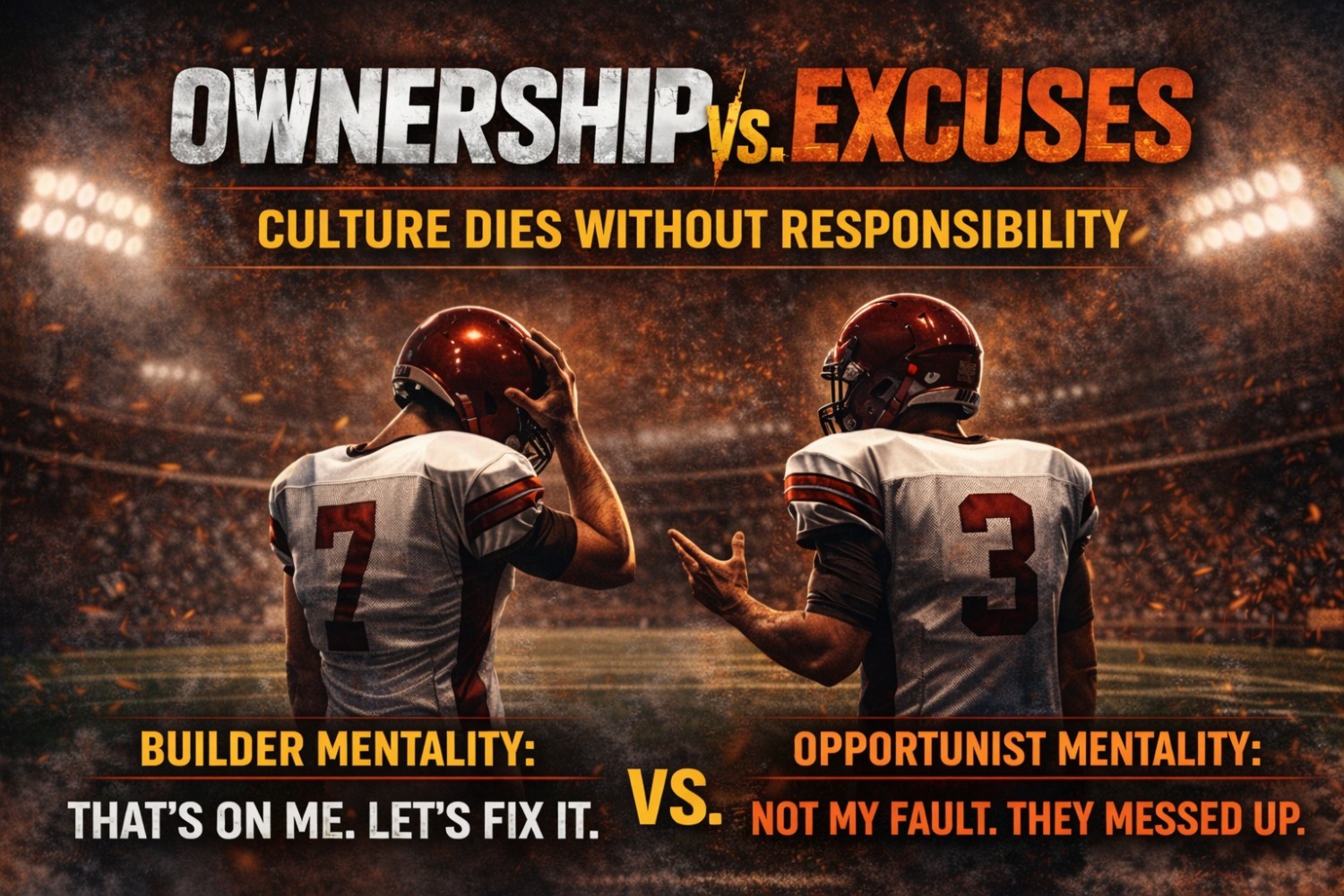
Every team wants accountability.
Very few teams practice it.
Because accountability sounds great — until it requires someone to look in the mirror instead of pointing across the room.
This is where culture either strengthens… or quietly collapses.
Strong Culture Starts With Ownership
Great teams don’t waste time assigning blame.
They assign ownership.
When something goes wrong, leaders don’t ask:
- “Who messed up?”
They ask: - “What’s my role in fixing this?”
That mindset spreads fast.
Ownership keeps teams moving forward.
Blame keeps teams stuck in the past.
And football has no patience for teams living in yesterday.
Weak Culture Loves Excuses
Excuses are comfortable.
They protect egos.
They delay growth.
You hear them all the time:
- “That wasn’t my assignment.”
- “The call was bad.”
- “We didn’t practice that look.”
- “He should’ve been there.”
Individually, excuses feel harmless.
Collectively, they destroy trust.
Once excuses are tolerated, accountability disappears — and culture follows.
Leadership Is Taking the Hit First
Real leadership isn’t loud.
It doesn’t need speeches.
It doesn’t wait for permission.
Leaders take responsibility before they’re asked.
They:
- Own mistakes publicly
- Correct issues privately
- Stay steady when emotions spike
- Pull teammates forward instead of calling them out
That behavior sets the standard.
And standards — not talent — are what teams fall back on when games get tight.
The Chain Reaction of Ownership
When ownership becomes the norm:
- Communication improves
- Trust increases
- Focus sharpens
- Execution speeds up
Players stop playing defensively.
They stop protecting themselves.
They start protecting the team.
That’s when football becomes simple again.
The Next-Play Principle Still Applies
Ownership doesn’t mean dwelling on mistakes.
It means acknowledging them quickly — then moving on together.
The most important play in football is still the next one.
Great teams don’t erase mistakes.
They respond to them.
That response is culture in action.
Opportunistic Teams Avoid Responsibility
Opportunistic teams struggle here.
When responsibility shows up, they:
- Deflect
- Disengage
- Disconnect
Why?
Because ownership requires commitment — and commitment doesn’t exist without loyalty to something bigger than yourself.
Builders own.
Opportunists explain.
Final Thought
Culture doesn’t break because of losses.
It breaks when responsibility gets passed around like a hot potato.
The teams that last — the teams that execute late — are built on people who say:
“That’s on me. Let’s fix it.”
That sentence does more for culture than any slogan ever will.