Every offensive coordinator loves the quick game.
Hitches. Bubbles. “Quick Now.”
Easy yards. Free access. Rhythm throws.
Except… they’re not always easy — especially when the quarterback’s footwork and hip mechanics aren’t part of the conversation.
This is where too many offenses fail their quarterbacks.
Football Truth #1
The defense doesn’t change based on hash marks — but quarterback mechanics do.
And if coordinators don’t respect that, they’re asking QBs to execute one of the hardest throws in football under the disguise of “quick.”
Hip Work Is the Hidden Variable in the Quick Game
Quarterbacks don’t throw with their arm first — they throw with their hips.
Specifically:
- Which hip is already unlocked
- Which hip must open
- Whether the feet are already loaded to the throwing direction
This matters every time the ball comes out fast.
Let’s break it down.
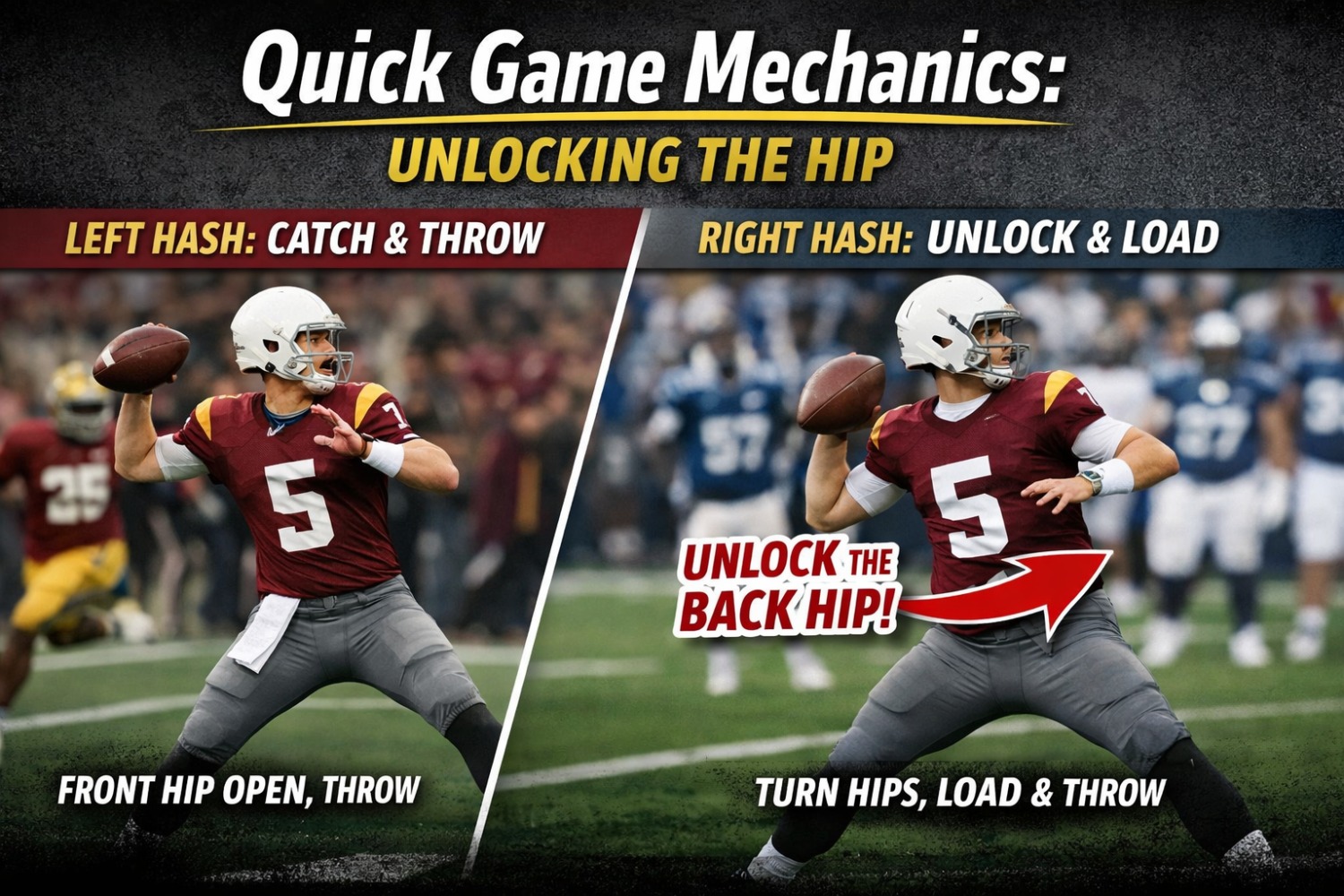
Non-Throwing Hand Side = Catch & Throw Simplicity
For a right-handed quarterback, throwing to the left side of the formation (non-throwing hand side) is mechanically clean.
Why?
- Front hip is already open
- Weight transfer is natural
- Feet are already aligned to deliver
The sequence:
- Catch the snap
- Replace feet
- Deliver the throw
No unlock. No re-load. No rush.
That’s true quick game.
Throwing Arm Side = Catch, Unlock, Load, Then Throw
Now let’s flip it.
Right-handed QB.
Quick throw to the right (throwing arm side).
Suddenly the mechanics change entirely.
Now you’re asking the quarterback to:
- Catch the snap (high, low, or perfect — doesn’t matter)
- Unlock the back hip
- Open the hips to the play side
- Load the feet
- Deliver an accurate throw — on rhythm
That’s not “catch and throw.”
That’s a full mechanical sequence under time pressure.
And depending on down, distance, and defensive leverage, it may be the hardest throw on the call sheet.
Hash Marks Change Everything (Whether We Admit It or Not)
Let’s use a real-world example.
Scenario A: Ball on the Right Hash
- Right-handed QB
- Quick throw to the right
This is the worst-case scenario mechanically.
The quarterback must:
- Catch the snap
- Turn the hips across the body
- Load to the throwing side
- Fire immediately
Any disruption — bad snap, pressure, timing issue — and the throw sails, dies, or arrives late.
That’s how “easy throws” become picks, drops, or hospital balls.
Scenario B: Ball on the Left Hash
Same quarterback. Same concept. Same defense.
Now:
- Front hip is already open
- Feet don’t need to reload
- Throw happens naturally in rhythm
Same play.
Completely different difficulty level.
This Isn’t a QB Problem — It’s a Play-Call Awareness Issue
When coordinators ignore:
- Hash placement
- Quarterback handedness
- Hip unlock requirements
They force quarterbacks to:
- Rush mechanics
- Throw without proper base
- Sacrifice accuracy for speed
And then we blame the QB for “missing an easy throw.”
It wasn’t easy.
It was mechanically stacked against him.
Coaching Takeaway: Match the Quick Game to the QB, Not the Whiteboard
Great play callers understand:
- Where the ball is
- Which hip is open
- Which direction requires extra work
They don’t just ask, “Is it open?”
They ask, “Can my QB throw this clean right now?”
That’s how rhythm offenses stay efficient.
That’s how quarterbacks play fast without playing reckless.
That’s how “quick” actually stays quick.
Final Thought for Our Quarterbacks
If you’ve ever wondered why a throw feels rushed on one side and smooth on the other — now you know.
It’s not confidence.
It’s not arm strength.
It’s hip work.
And if your coordinator understands that?
Congratulations — you’re playing chess while others are still drawing plays in the dirt.
At Capital QB’s, we don’t just teach throws.
We teach why they work — and when they don’t.
Because mechanics don’t lie — even when play sheets do. 🏈