
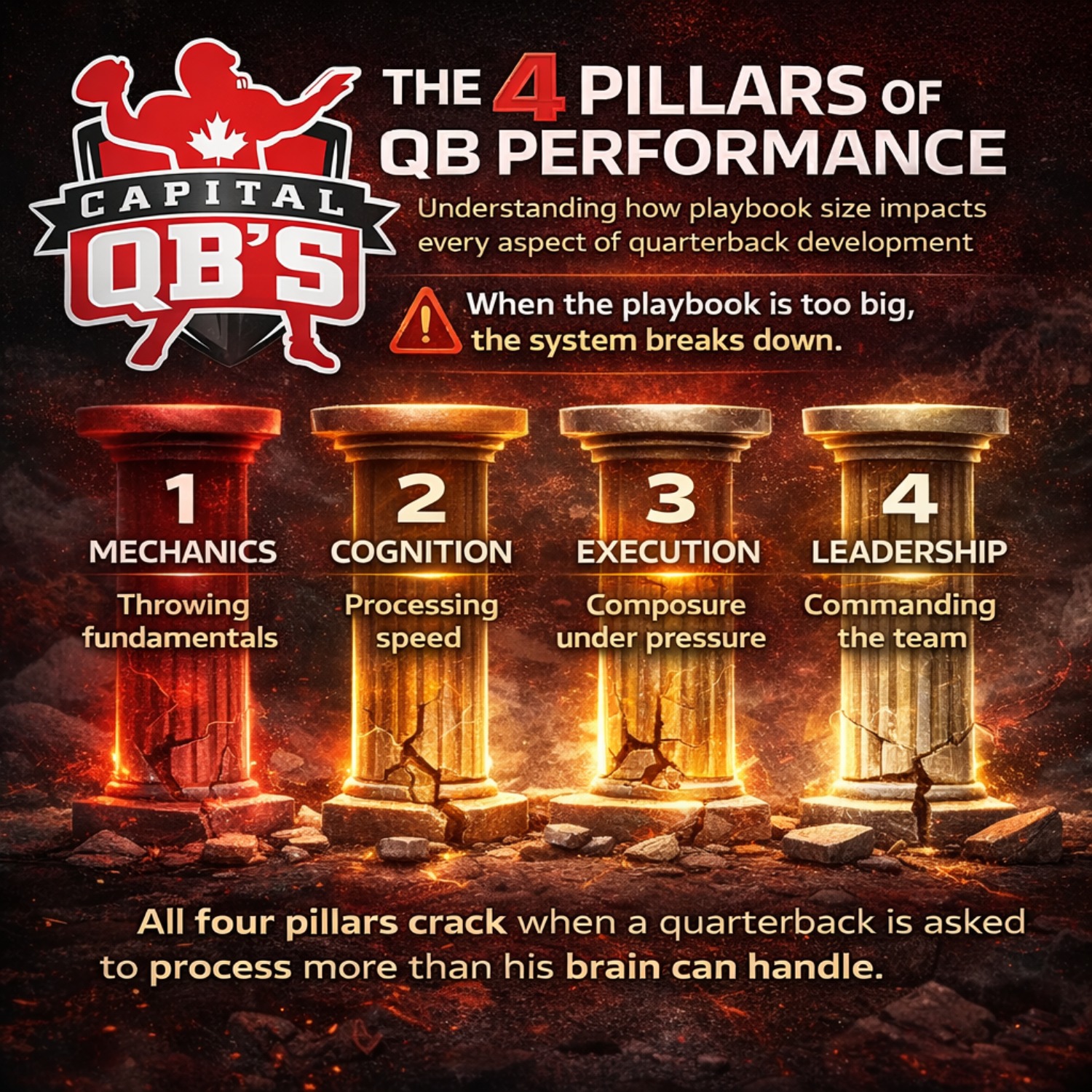
Understanding how playbook size impacts every aspect of quarterback development
Every quarterback’s performance is built on four interconnected pillars. When a playbook grows beyond a quarterback’s cognitive capacity, all four pillars begin to crack—creating performance problems that are often misdiagnosed as lack of talent, poor football IQ, or mental weakness.
In reality, the issue is usually cognitive overload, not ability.
Pillar 1: Mechanics
Physical execution of throwing fundamentals
When Within Capacity
- Smooth, repeatable footwork
- Consistent release point
- Proper weight transfer
- Relaxed upper body
- Full follow-through on throws
Under Cognitive Overload
- Rushed, choppy footwork
- Inconsistent arm slot
- Weight stuck on the back foot
- Tense shoulders and grip
- Short-armed, inaccurate throws
Real Example:
A high school QB looks sharp in 7-on-7 but suddenly “loses his mechanics” in games. His body isn’t broken—his brain is overwhelmed trying to process 25+ plays. When processing slows, the body rushes to compensate.
Pillar 2: Cognition
Mental processing and decision-making under pressure
When Within Capacity
- Rapid pattern recognition
- Confident pre-snap decisions
- Fast post-snap adjustments
- Anticipatory throwing
- Clear progression through reads
Under Cognitive Overload
- Analysis paralysis at the line
- Late recognition of defensive looks
- Reactive instead of anticipatory decisions
- Tunnel vision on the first read
- Mental fog and confusion
Real Example:
A youth QB “knows the playbook” in meetings but can’t execute in games. With 15+ plays, each snap becomes a two-second math problem involving dozens of possible outcomes. The brain simply cannot process that volume at game speed.
Pillar 3: Execution
Staying composed and translating practice to game performance
When Within Capacity
- Calm, confident demeanor
- Practice reps show up on game day
- Automatic recall under stress
- Quick recovery after mistakes
- Plays feel “installed in the body”
- Instinctive reactions
Under Cognitive Overload
- Visible panic and hesitation
- Knows the play but can’t execute it
- Sharp in walkthroughs, lost in games
- Fear of making mistakes
- Requires conscious recall before every snap
- Practice does not transfer
Real Example:
A college QB who was confident in high school now looks scared and hesitant. This isn’t a “mental toughness” issue—when a QB is unsure of 30% of his reads due to overload, anxiety is a natural response. Reduce the playbook to 20 plays and execution returns.
Pillar 4: Leadership
Commanding the huddle and rallying teammates
When Within Capacity
- Commands the huddle with authority
- Vocal and decisive at the line
- Confident body language
- Takes ownership of mistakes
- Rallies teammates after setbacks
- Teammates trust his decisions
Under Cognitive Overload
- Quiet and hesitant in the huddle
- Constantly looks to the sideline
- Slumped shoulders deflate the offense
- Blames others or the play call
- Can’t inspire confidence when unsure himself
- Teammates lose belief
Real Example:
A youth QB who was once vocal goes silent after being handed a 20-play offense. You can’t lead with conviction when your brain is drowning in uncertainty. Simplify to 10 core plays and leadership re-emerges.
⚠️ The Cascade Effect
These pillars do not fail independently. Cognitive overload triggers a chain reaction:
- Brain overload
Too many plays → decision paralysis - Mechanics break down
The body rushes to compensate - Execution fails
Anxiety rises, practice stops translating - Leadership disappears
A QB can’t command others when unsure himself
The Bottom Line
Quarterbacks don’t struggle because they lack talent.
They struggle when the system outpaces their capacity.
Right-size the playbook, and you don’t just fix one problem—you restore mechanics, cognition, execution, and leadership all at once.
That’s how quarterbacks actually develop.
Try our new QBIQ Diagnostic assessment to see how many plays you can handle from your playbook.







One thought on “The 4 Pillars of QB Performance”