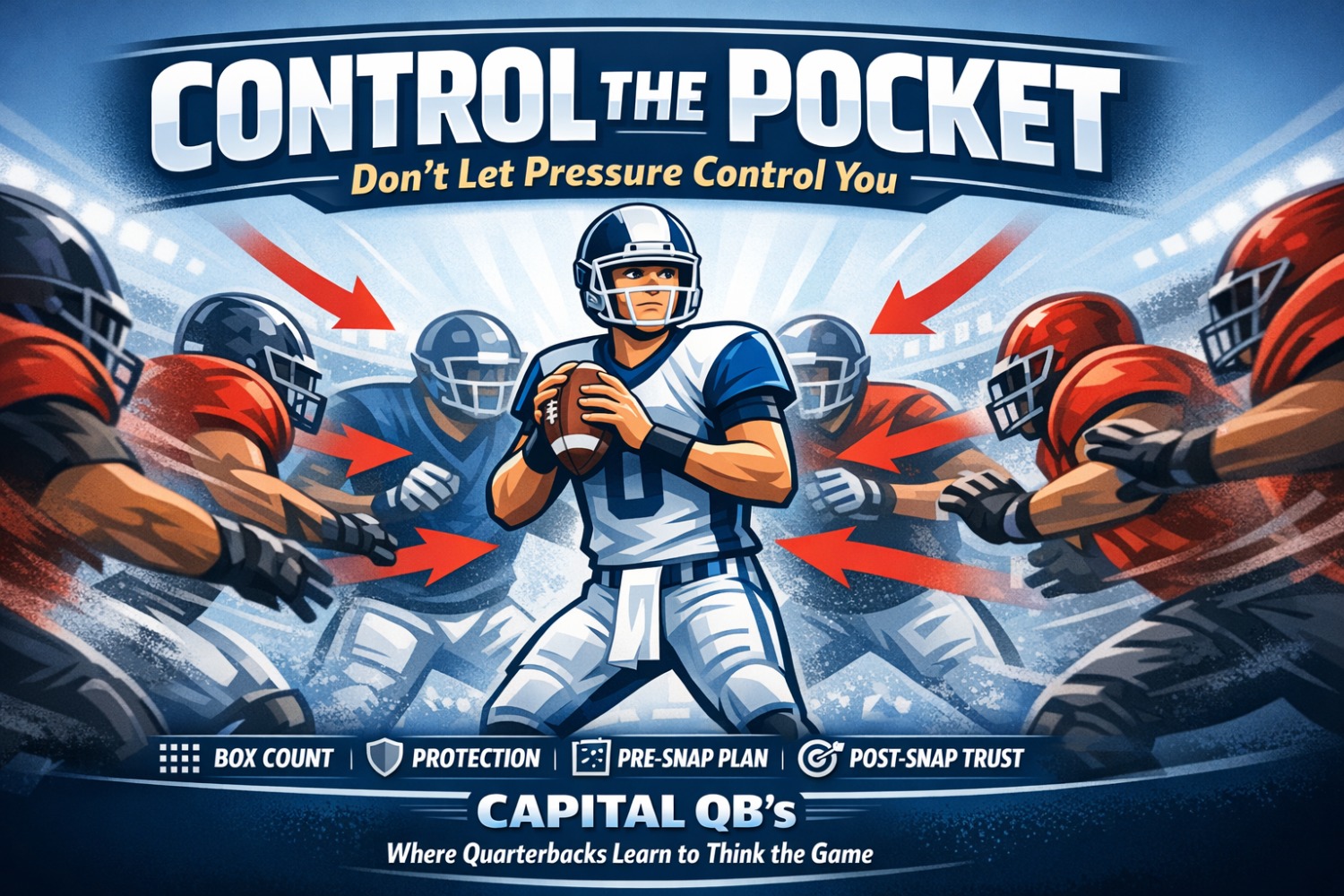
Pressure doesn’t just rush throws.
It rushes decisions.
And for most quarterbacks, pressure isn’t what actually hits them — it’s what they think is about to hit them.
Let’s break this down the right way.
Step 1: Pressure Starts with the Box Count
Before you even worry about blitzes, twists, or exotic fronts, pressure begins with math.
Football is simple before it’s complicated.
Your Backfield Determines the Front You’ll Face
- Single Tailback (1-back set)
👉 Expect a 6-man box most of the time
(4 down + 2 backers or 3 down + 3 backers) - Fullback + Tailback (2-back set)
👉 Expect a 7-man box - Two Tailbacks / Heavy Personnel
👉 Defense is now comfortable living in a 7-man front and flirting with an 8th late
Why?
Because defenses align based on blockers vs. threats.
If you add a blocker, they add a defender.
Simple math. No panic required.
Step 2: Pressure Is Situational, Not Emotional
Pressure doesn’t mean blitz.
Pressure means time stress.
And time stress is dictated by:
- Down & Distance
- Field Position
- Personnel
- Game Situation
Examples:
- 3rd & Long → Higher chance of simulated pressure
- 2nd & Medium → Defense may rush four and play coverage
- Red Zone → Pressure is tighter, not faster
- Backed Up → Defense wants you to make a mistake, not necessarily sack you
Young quarterbacks confuse urgency with danger.
Those are not the same thing.
Step 3: The Real Enemy Is “Felt Pressure”
Here’s where most quarterbacks get themselves in trouble.
When a QB feels pressure — whether it’s real or not — they do one of three things:
- Rush the throw
- Abandon their reads
- Throw the ball “to an area” instead of a target
That’s not quarterbacking.
That’s survival mode.
And survival mode creates:
- Late throws
- Floating balls
- Bad interceptions
- Happy feet
- Broken mechanics
When a quarterback has time, they trust the progression.
When they think they don’t, they abandon it.
Step 4: Pressure Is Beaten Pre-Snap, Not Mid-Panic
Elite quarterbacks don’t beat pressure with athleticism.
They beat it with anticipation.
Here’s how:
Pre-Snap Checklist
- Count the box
- Identify the Mike
- Locate the extra hat
- Understand protection vs. route concept
- Know where the answer is
Pressure is manageable when you already know:
“If they bring one more than we can block, this is where the ball goes.”
That decision should already be made.
Step 5: Time Is a Weapon — If You Trust It
A clean pocket doesn’t mean a perfect pocket.
It means functional time.
Quarterbacks who trust protection:
- Keep their base
- Stay patient
- Let routes develop
- Make defenders wrong
Quarterbacks who fear pressure:
- Drift
- Shorten reads
- Lock onto one option
- Miss easy completions
The difference isn’t arm talent.
It’s mental discipline.
Final Thought for Capital QB’s
Pressure isn’t something to fear.
It’s something to understand.
The quarterback who knows:
- how many blockers he has
- how many defenders they can bring
- and where the pressure answer lives
…will always play faster than the defense.
Slow mind = fast game.
Fast mind = rushed game.
And at Capital QB’s, we don’t train quarterbacks to survive pressure.
We train them to control it.
Join the Tuesday Night Throwing Sessions