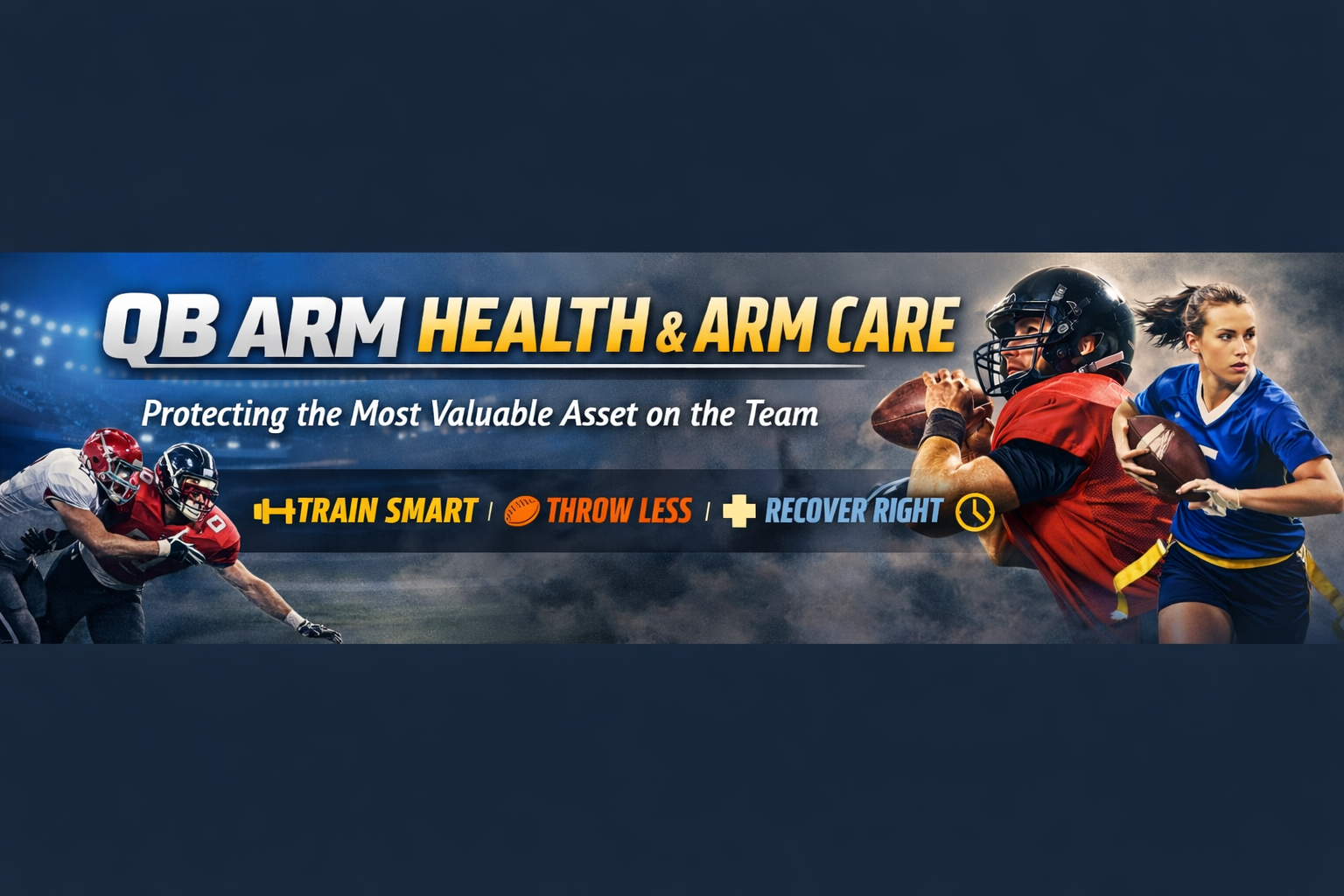
How to Protect the Most Valuable Asset on the Team
Being the only quarterback on a team is both an honor and a heavy load. You take every rep. You throw every drill. You carry every expectation.
And if you don’t manage your arm properly, that role can quietly turn into fatigue, soreness, or injury — especially for young quarterbacks whose bodies are still developing.
The truth?
Quarterback arm health isn’t about throwing more. It’s about throwing smarter.
Let’s break down what parents and players need to know.
First: Why QB Arm Fatigue Happens
Arm pain doesn’t usually come from one big throw. It comes from accumulation:
- Too many throws, too often
- Poor mechanics (especially footwork & sequencing)
- Not enough recovery
- No offseason structure
- Playing QB year-round without a plan
Your arm isn’t just your shoulder or elbow.
It’s a full kinetic chain — feet, hips, core, torso, shoulder, elbow, wrist.
If one link breaks down, the arm pays the price.
THE BIG RULE
🛑 Your arm should never be the strongest part of your throw
If your arm is doing all the work, it will not last.
OFFSEASON: How to Build a Bulletproof QB Arm
The offseason is where arms are protected, not abused.
1. Throw Less — But With Purpose
Offseason throwing should be:
- 2–4 days per week
- Shorter sessions
- Technique-focused, not volume-based
You don’t need 150 throws to get better.
You need clean reps.
Quality reps beat tired reps. Every time.
2. Build the Engine (Lower Body & Core)
Healthy arms come from:
- Strong glutes
- Stable hips
- Rotational core strength
Focus on:
- Squats & lunges
- Single-leg balance work
- Medicine ball rotational throws
- Anti-rotation core exercises (planks, dead bugs)
When your lower body drives the throw, your arm survives the season.
3. Shoulder Care ≠ Heavy Weights
Forget ego lifting.
Instead:
- Resistance bands (external/internal rotation)
- Scapular control exercises
- Light dumbbells (high reps, low weight)
- Mobility over max strength
This is maintenance, not bodybuilding.
4. Mechanics Matter More Than Muscles
Most arm pain we see comes from:
- Over-striding
- Late hip rotation
- Dropping the elbow
- Throwing without proper footwork
Fix the feet → hips clean up → arm stress drops.
This is why offseason is the best time for technical QB training, not just “throwing routes.”
IN SEASON: How to SURVIVE as the Only QB
This is where most mistakes happen.
1. You Don’t Need Every Rep
Being the starter does not mean:
- Throwing every drill
- Repping every scout look
- Taking every warm-up throw
Smart quarterbacks:
- Take mental reps
- Rotate throws with backups
- Save their arm for game-speed reps
Arm health is a long game, not a toughness contest.
2. Game Week Throwing Guidelines
On a typical week:
- Heavy throw day: early in the week
- Light throw days: closer to game day
- Day before game: short, sharp, clean
If your arm feels heavy late in the week, you did too much earlier.
3. Learn the Difference: Sore vs Pain
This is critical for parents and players.
- Soreness: tight, dull, improves with movement
- Pain: sharp, lingering, worsens with throwing
Pain is a stop sign.
Ignoring it doesn’t make you tough — it makes you unavailable.
4. Recovery Is Not Optional
Every QB should have:
- Proper sleep
- Hydration
- Light stretching
- Post-practice band work
- At least 1 full rest day per week
Your arm recovers when you’re not throwing.
YEAR-ROUND QB WARNING 🚨
Playing:
- Spring football
- Summer camps
- Fall season
- Winter training
…with no break is the fastest way to arm issues.
Even elite quarterbacks need throwing deload periods.
Rest is not falling behind.
Rest is staying in the game.
FOR PARENTS: What to Watch For
Red flags:
- Constant icing just to get through practice
- Complaints of elbow or shoulder pain
- Declining velocity or accuracy
- Changes in mechanics late in games
If a young QB is hurting, it’s not “part of the process.”
It’s feedback — and it matters.
THE SMART QB MINDSET
The best quarterbacks understand this:
Availability is your greatest ability.
A tired arm doesn’t win games.
A healthy, efficient quarterback does.
That’s why modern QB development focuses on:
- Decision-making
- Footwork
- Timing
- Mental reps
- Efficient mechanics
Not just throwing until the arm is cooked.
Final Thought
Being the only quarterback is pressure.
But managing your arm properly is leadership, not weakness.
Train smart.
Recover harder.
Protect the arm — and the season takes care of itself.
If you want structured, quarterback-specific training that actually reduces arm stress while improving performance, that’s exactly why programs like Capital QB’s and our QBDT mental & mechanical training exist.
Smart QBs last longer.
And the long game always wins. 🏈💪