
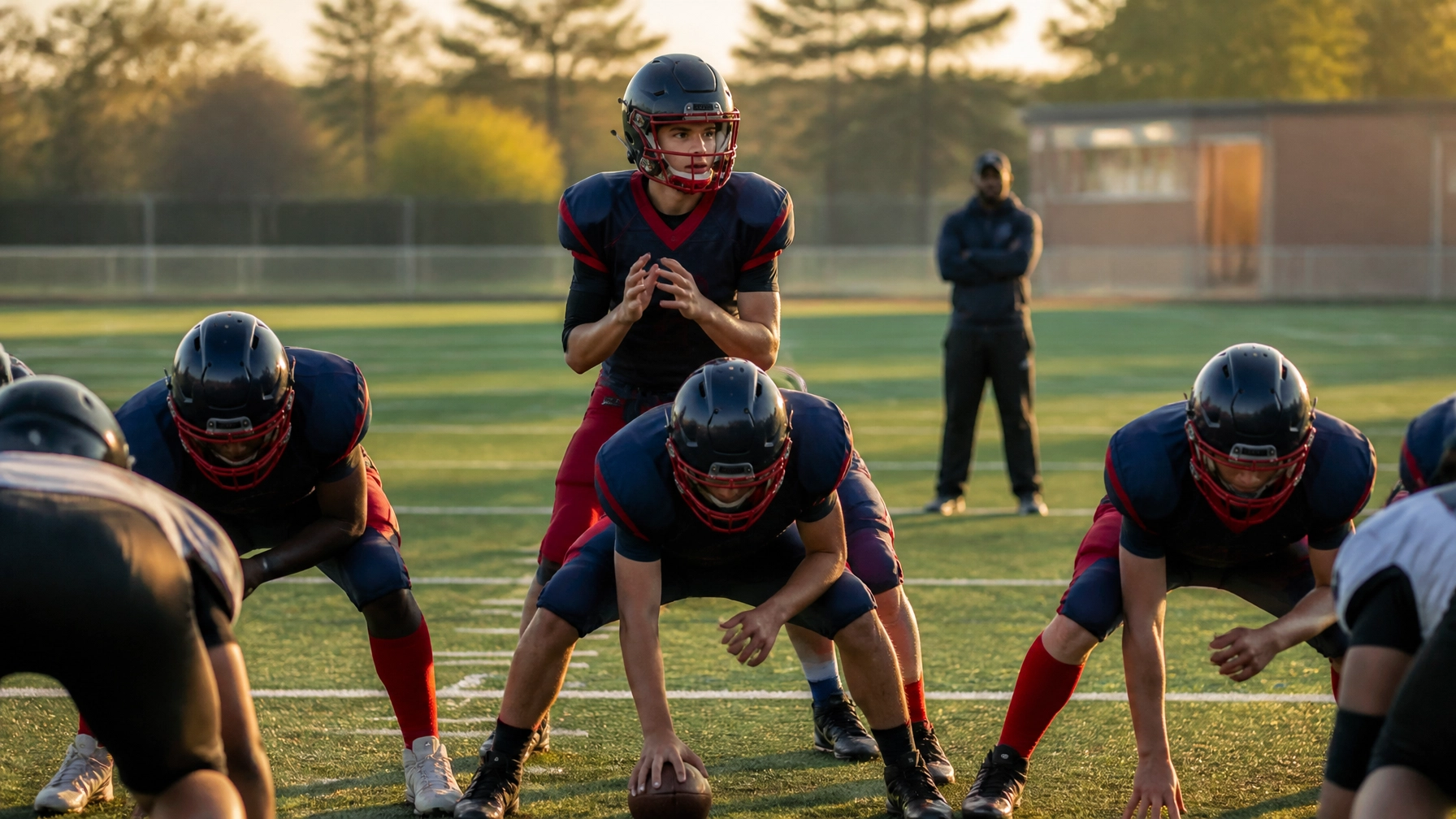
There is an old saying that football is 90% mental and 10% physical. That is not a scientific formula, but it captures an important truth:
The quarterback position begins with processing information.
From the moment you leave the huddle, you must understand the play, identify the defensive look, communicate with your teammates, and prepare to make a decision. Then the ball is snapped, the picture changes, and you must do it all again.
That cycle repeats every play.
A great quarterback is not simply the athlete with the strongest arm. A great quarterback is a complete player who can lead, adapt, move, throw, and make sound decisions under pressure.
At Capital QBs, we develop that complete quarterback through our L.E.A.D. Philosophy:
- Leadership: Inspire confidence and set standards.
- Extension of Plays: Improvise under pressure.
- Athleticism: Build endurance and perform under pressure.
- Decision Making: Apply tactical knowledge and intuition.
Let’s break down the mental and physical attributes every youth quarterback should develop.
The First Misconception: Great Quarterbacks Are Defined by Arm Strength
Arm strength is useful. It allows a quarterback to attack more areas of the field and make throws from difficult positions.
But arm strength alone does not make a quarterback great.
A quarterback with a powerful arm who cannot read the defense, manage the offense, or protect the football will struggle. Meanwhile, a quarterback with average physical tools can become extremely effective through preparation, accuracy, timing, leadership, and decision-making.
When a quarterback is within capacity
- The playbook is organized and understood.
- The defense is scanned before the snap.
- The quarterback identifies the primary read and the best answer.
- The feet stay balanced.
- The decision is made on time.
When a quarterback is under overload
- The playbook is memorized without being understood.
- The quarterback stares at one receiver.
- The feet become rushed or frozen.
- The ball is held too long.
- A late decision becomes a turnover.
⚠️ The warning: Do not confuse knowing more plays with being more prepared. Usable knowledge beats overloaded knowledge.
Three Mental Attributes Every Youth QB Needs
1. Retainability: Learn What You Can Apply
Retainability is your ability to learn, organize, and recall information.
Many quarterbacks can memorize 40 or 50 plays. The real challenge is applying those plays against a moving defense. You must know more than the route names and assignments. You must understand why the play was called and what defensive look it is designed to attack.
This is where the Capital QBs SAD method becomes valuable:
- Scan the defense.
- Analyze the alignment, leverage, motion, and coverage indicators.
- Decide where the ball should go and commit to the decision.
Think of your brain like a computer. A large playbook is not helpful if your system slows down when the pressure rises. Your goal is to build a clear mental operating system that allows you to process information quickly.
✓ Action checklist:
- Learn the formation before memorizing every detail.
- Identify each player’s assignment.
- Know the purpose of the play.
- Study which defender controls your read.
- Practice explaining the play in your own words.
The Bottom Line: A great quarterback does not simply remember the play. They understand how the play works.
2. Coachability: Become a Student of the Position
Coachability means more than listening quietly.
A coachable quarterback asks questions, accepts correction, applies feedback, and returns to practice ready to improve. This quality accelerates development because every coaching point becomes part of your game.
The quarterback is also the offensive leader on the field. Your teammates may forget an assignment or become uncertain about their route. If you understand the offense, you can provide clarity in the huddle and during practice.
That does not mean criticizing teammates. It means becoming dependable.
When your receiver asks, “What do I run on this play?” you should be able to answer clearly.
Study your playbook. Take notes. Ask your offensive coordinator why a concept is designed a certain way. Watch film with a purpose.
The Bottom Line: Coachability turns instruction into performance. Your response to correction matters as much as your current skill level.
3. Processability: Make the Right Decision on Time
Processability is your ability to take information and turn it into action.
In Canadian football, you may have only a short window between the huddle and the snap to organize the play, identify defensive indicators, and prepare your response. In many situations, that window can be approximately 20 seconds.
The defense is giving you clues:
- Where are the safeties aligned?
- Is the box loaded?
- Which defender has outside leverage?
- Is the defense showing pressure?
- What changes when a receiver goes in motion?
You do not need to identify everything. You need to identify the information that matters most for the play.
In a 12-man game with a wider field, additional space, motion, and three downs, decision-making becomes especially important. You must understand when to attack, when to take the safe completion, and when to protect field position.
⚠️ Do not make every decision an arm-strength contest. The best throw is often the one that arrives safely and keeps the offense on schedule.
The Bottom Line: Processing speed is not reckless speed. It is calm, accurate thinking under pressure.

Three Physical Attributes That Support Quarterback Performance
Mental skills control the decision. Physical skills allow you to execute it.
You do not need to look or play like another quarterback. A smaller, mobile quarterback may create advantages with athleticism and movement. A taller quarterback may see the field differently and attack with arm strength.
Know your strengths. Develop your weaknesses. Build a style that fits your abilities.
1. Footwork: The Foundation of Timing and Accuracy
Quarterback footwork is not about performing flashy moves. It is about creating balance, rhythm, and time.
Inside the pocket, your movement may consist of controlled six-inch steps, subtle slides, hitches, and resets. These small movements help you avoid pressure while keeping your eyes downfield.
Once you leave the pocket, you become an athlete in space. That requires a different movement pattern, but the foundation remains the same: balance, body control, and ball security.
Slow feet can create several problems:
- The quarterback reaches the launch point late.
- The throwing base becomes inconsistent.
- The ball is released while the body is falling away.
- The quarterback holds the ball because the feet are not ready.
- Pressure arrives before the decision can be executed.
A focused quarterback should regularly train stance, drops, pocket movement, sprint-outs, change of direction, and reset throws.
✓ Footwork checklist:
- Keep your eyes up while moving.
- Maintain a balanced base.
- Match your drop to the route timing.
- Use small pocket movements instead of unnecessary dancing.
- Reset your feet before throwing whenever possible.
The Bottom Line: Your feet are the steering wheel of your passing game. If your feet are late, your decisions and throws will usually be late too.

2. Throwing Variety: Build More Than One Type of Throw
Not every play requires a 10-yard out route or a 50-yard go ball.
A complete quarterback must control the football for different situations. That includes throws from a static position, throws on the move, and throws made with imperfect body alignment.
Your training should include:
- Quick-release throws.
- Short and intermediate level throws.
- Touch passes over underneath defenders.
- Screen throws.
- Throws from movement.
- Bad-body throws when pressure disrupts your base.
- Layered throws that place the ball away from coverage.
- Red-zone and goal-line throws.
The goal is not to throw hard every time. The goal is to understand the required trajectory, velocity, location, and timing for each situation.
Before training, study the plays you are expected to execute. Ask yourself:
What type of throw does this concept require from me?
That question connects your technical training to your offensive system.
The Bottom Line: Great quarterbacks do not have only one gear. They change the throw to match the situation.
3. Ball Handling: Protect the Possession
Ball handling is one of the most basic quarterback responsibilities, and one of the easiest to overlook.
Every exchange must be clean. Every handoff must be secure. Every scramble must begin with ball protection. When you move through traffic, use your core strength and keep two hands on the football whenever the situation allows.
A quarterback who protects the ball gives the offense more opportunities. A quarterback who treats the football casually puts the entire team at risk.
Practice:
- Center exchanges.
- Handoff mechanics.
- Play-action fakes.
- Pocket escapes.
- Two-hand ball carriage.
- Transitioning from a throw fake into a run.
- Protecting the ball when contact is approaching.
⚠️ The warning: A big play never erases the cost of an unnecessary turnover. Ball security is a leadership responsibility.
The L.E.A.D. Standard for a Complete Quarterback
The mental and physical traits above connect directly to the four parts of the Capital QBs L.E.A.D. Philosophy.
Leadership
You inspire confidence through preparation, communication, accountability, and consistent effort.
Extension of Plays
You stay alive when the original play breaks down. You keep your eyes up, protect the football, and create positive opportunities under pressure.
Athleticism
You build the endurance, mobility, footwork, balance, and physical toughness required to perform late in games.
Decision Making
You scan, analyze, and decide. You apply tactical knowledge and intuition without panicking or forcing the ball.
A Practical Development Checklist for Young Quarterbacks
Use this checklist during the off-season:
✓ Mental preparation
- Can you explain the purpose of each play?
- Can you identify the key defender in your read?
- Can you recognize basic defensive indicators?
- Do you recover quickly after a mistake?
- Do you accept coaching without becoming discouraged?
✓ Technical development
- Is your stance balanced?
- Are your drops consistent?
- Can you throw accurately from movement?
- Can you complete quick-release and touch throws?
- Do you protect the football during handoffs and scrambles?
✓ Leadership development
- Do you know every teammate’s assignment?
- Do you communicate clearly in the huddle?
- Do you set the standard through your effort?
- Do you hold yourself accountable first?
- Do your teammates trust your preparation?
Develop the Quarterback, Not Just the Thrower
There are many skills involved in quarterback development: footwork, progression, release, accuracy, arm strength, alignment, assignment, vision, reaction, route concepts, play action, physicality, and production.
But these skills do not develop in isolation.
Your footwork affects your accuracy. Your playbook knowledge affects your decisions. Your decisions affect your leadership. Your leadership affects the confidence of the entire offense.
That is the cascade effect of quarterback development.
At Capital QBs, our goal is to develop quarterbacks who can perform technically, think tactically, and lead consistently. Coach Ron Raymond brings more than 30 years of quarterback and coaching experience to the position, including offensive and defensive experience that helps players understand how defenses attack.
Learn more about Coach Ron Raymond and his coaching background, or explore the Junior Quarterback Training Program for athletes aged 10 to 13 and the Senior Fundamentals Program for quarterbacks aged 14 to 19.
Train With Capital QBs This Winter
If you want to keep developing in the off-season, Capital QBs is here to help.
We invite quarterbacks and families to join our winter workout sessions and our 5-week virtual Zoom lessons starting in January. These sessions are designed to help you stay sharp, build confidence, and continue developing the full L.E.A.D. standard of quarterback play.
Whether you need structure, extra reps, or a better plan for your off-season, this is your opportunity to keep moving forward with purpose.
✓ Next step:
- Join Capital QBs winter workout sessions.
- Register for the 5-week virtual Zoom lessons starting in January.
- If you have questions, reach out to Coach Ron Raymond through the Contact Us page.
The Bottom Line: A great quarterback is not defined by one throw, one measurement, or one game.
A great quarterback prepares with purpose, moves with control, decides with confidence, and leads every play.








One thought on “What Makes a Great Quarterback? Mental and Physical Attributes Every Youth QB Needs”