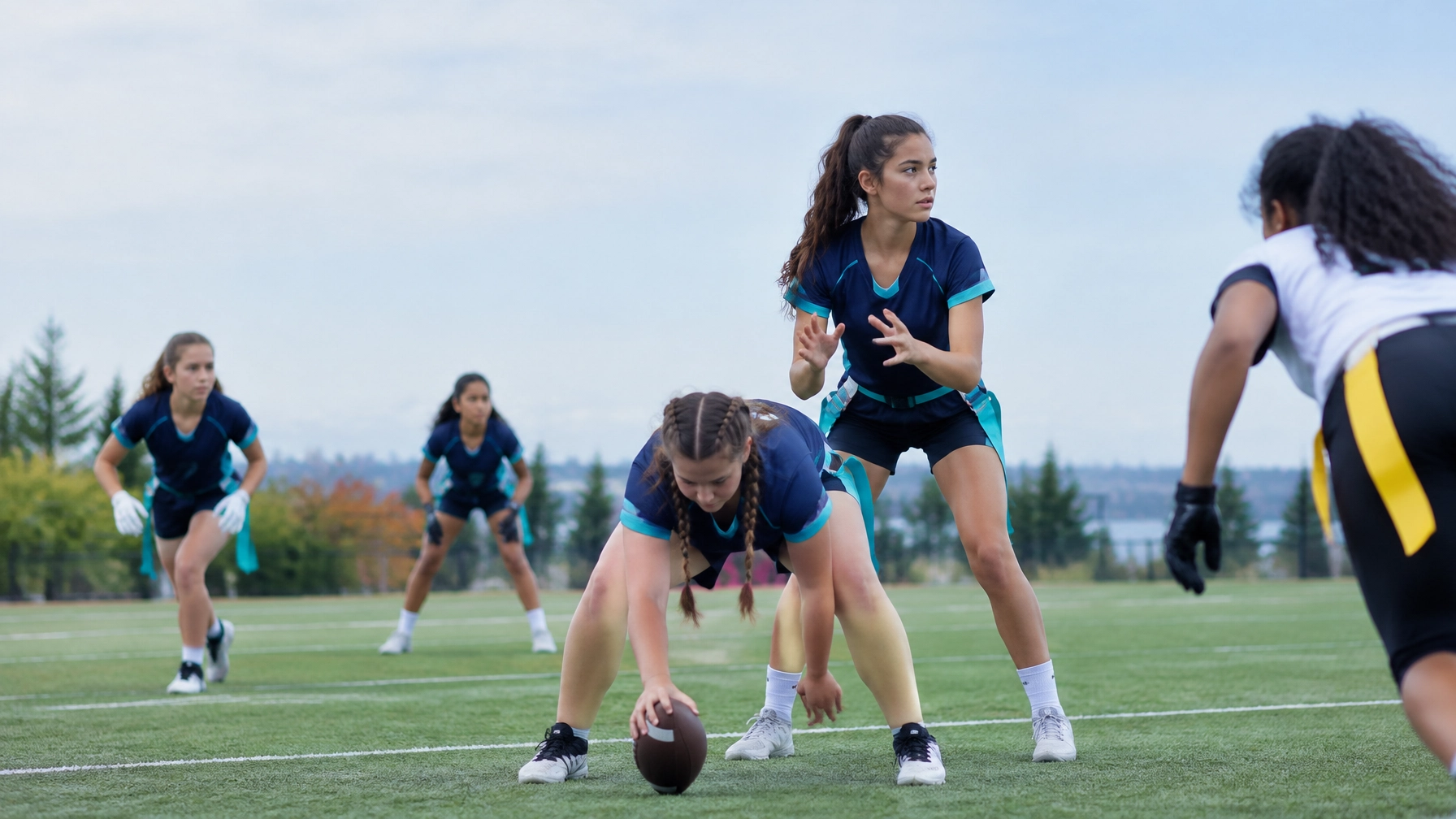
In 5v5 girls flag football, quarterback footwork directly affects timing, accuracy, and decision-making.
You can understand the concept. You can identify the coverage. You can know exactly where your receiver is going. But if your feet are late, disconnected, or pointed away from your target, the throw will often be late too.
That is why Capital QBs teaches quarterbacks to connect route concepts, route depth, and footwork.
Your feet should tell the same story as the play. When your receiver reaches the correct depth, your body should be ready to deliver the football.
This article focuses on two essential techniques:
- The Grab and Plant
- The Semi Rollout
Both techniques help you work quickly, stay balanced, and throw from a stronger platform under pressure.
Why Footwork Matters in 5v5 Flag Football
Flag football gives the quarterback less space and less time to operate. The rusher can force you away from your first intended platform, while defenders may take away the easiest throwing lane.
That creates a simple cause-and-effect chain:
Poor footwork → poor body position → late or inaccurate throw → difficult catch or turnover.
The solution is not to rush every throw.
The solution is to develop footwork that matches:
- The offensive concept
- The depth of the route
- The direction of pressure
- The position of your throwing platform
Think of your footwork as the timing mechanism of the offense. Your feet help determine when the ball comes out.
A short route requires a quicker gather and release. A deeper route may require more patience and controlled depth. A rollout requires you to move while keeping your eyes and body connected to the receiver.
The Bottom Line: Your feet should not move randomly after the snap. Every step must support the route, the read, and the throw.
The L.E.A.D. Connection
Capital QBs develops complete quarterbacks through the L.E.A.D. Philosophy:
- Leadership: Inspire confidence and set standards.
- Extension of Plays: Improvise under pressure.
- Athleticism: Build endurance and perform under pressure.
- Decision Making: Apply tactical knowledge and intuition.
Footwork connects all four areas.
A quarterback demonstrates Leadership by being prepared and consistent. She demonstrates Extension of Plays by moving away from pressure without losing throwing posture. She demonstrates Athleticism by controlling her body in space. She demonstrates Decision Making by understanding when to plant, when to throw, and when to move.
The quarterback must help raise the team’s communication, preparation, and work ethic on the field. She also needs to make sure she and her OC are on the same page and communicate with each other when needed.
Good footwork is part of that standard.
Technique One: The Grab and Plant
The Grab and Plant is a quick, rhythmic footwork technique that allows the quarterback to catch the snap, establish her base, and deliver the football on time.
For a right-handed quarterback, the basic rhythm is:
Catch the snap, Left, Right, Ball out.
For a southpaw, the rhythm mirrors the movement:
Catch the snap, Right, Left, Ball out.
This sequence should feel controlled and repeatable. It is not a large drop. It is not a jump backward. It is a compact movement that helps the quarterback match her feet to the timing of the route.
Right-Handed Quarterback
For a right-handed thrower:
- Catch the snap securely.
- Time the snap with your left foot.
- Load your back foot.
- Move through the left-right rhythm.
- Plant and get the ball out.
The quarterback should not allow the ball to drift away from the body. Secure it near the chest, get the eyes up, and begin processing the concept immediately.
The goal is to create a stable platform without wasting movement.
For a short route, the ball may come out immediately after the plant. For a route with more depth, the quarterback may need to hold the position for a moment while confirming the read.
Southpaw Quarterback
The southpaw quarterback uses the opposite rhythm:
Catch the snap, Right, Left, ball out.
The same principles apply. The movement simply mirrors the throwing side.
The quarterback must avoid treating the southpaw footwork as a completely different skill. It is the same concept with the opposite sequence: secure the snap, establish the base, align the body, and deliver on time.

Match the Grab and Plant to Route Depth
The Grab and Plant only works when it connects to the receiver’s route.
Before the snap, ask:
- What is the primary concept?
- Which receiver is expected to be open first?
- How deep is that route?
- Where will the receiver be when my feet finish?
A quarterback should not automatically throw after the same number of steps on every play. The route depth and defensive picture determine the timing.
When Within Capacity
- Your feet finish as the receiver reaches the correct break point.
- Your shoulders remain balanced.
- Your eyes stay downfield.
- Your front side points toward the target.
- The ball comes out on time.
Under Overload
- You rush the footwork before reading the defense.
- Your feet stop while your arm continues.
- You throw while leaning backward.
- Your shoulders point away from the receiver.
- You wait too long and allow the rusher to control the play.
⚠️ Warning: Do not confuse fast footwork with frantic footwork. Fast footwork is efficient. Frantic footwork causes your body to lose connection with the throw.
Technique Two: The Semi Rollout
The Semi Rollout gives the quarterback a way to work both sides of the field while responding to the rusher.
In 5v5 flag football, the rusher may force you into different throwing platforms. If you only practice throwing from one spot, you will struggle when the defense takes that spot away.
You need to train rolling:
- To your throwing side
- Away from your throwing arm
- With pressure arriving from different angles
- While keeping your eyes on the receiver
The Semi Rollout is not a full sprint to the sideline. It is a controlled movement that creates space and improves the throwing angle.
Rolling Toward Your Throwing Side
For a right-handed quarterback rolling to the right, you may need to lose a little ground to gain ground.
That means you may move slightly backward or laterally before gaining space toward the receiver. This is not wasted movement if it helps you avoid the rusher and create a clean throwing lane.
As you move, keep your body connected to the target.
In tackle football, we often describe this as:
Get your belt buckle to the target.
Your belt buckle represents the direction of your hips and the front of your body. You do not want your hips running one direction while your throw travels another.
You also need to understand your ankle eye.
The ankle eye is the large bone on the inside of the back-foot ankle (the medial malleolus). It helps you recognize where your lower body is pointing. The outside bone points toward your end zone. We want the big bone on the inside pointing toward your receiver or target. When your ankle eye, hips, and belt buckle are working toward the receiver, you have a better chance of creating an accurate platform.
Your ideal sequence is:
- Catch the snap.
- Move away from the rusher.
- Keep your eyes downfield.
- Get your belt buckle toward the target.
- Align your ankle eye with the throw.
- Plant and deliver.
Rolling Away from Your Throwing Arm
Rolling away from your throwing arm is more difficult because your body naturally wants to turn away from the target.
For a right-handed quarterback, this usually means rolling to the left. For a left-handed quarterback, it usually means rolling to the right.
When you roll away from your throwing arm, focus on two details:
- Get the ball to your back shoulder.
- Get your throwing ankle eye to the target.
Moving the ball to your back shoulder helps protect it from the rusher and gives you room to transition into the throw.
Your throwing ankle eye must help guide your lower body back toward the receiver by getting the big bone on the inside of your ankle pointed back at the target. You may not have the perfect platform every time. That is normal. The objective is to create the best possible platform under pressure.

⚠️ Important: Do not force a perfect textbook position when the rusher has already changed the play. Good quarterbacks understand the difference between an ideal platform and a functional platform.
The ideal platform has:
- Balanced feet
- Hips toward the target
- Ankle eye aligned with the throw
- Shoulders ready to rotate
- Eyes downfield
The functional platform may involve:
- A wider base
- A shorter stride
- A partial turn
- A quicker release
- A throw from a less-than-perfect position
The quarterback’s job is to remain accurate and make the best decision available.
A Simple Semi Rollout Progression
Use this progression when practicing:
Step 1: Walk Through the Movement
Start without a rusher. Catch the snap, roll right, and identify the receiver. Then repeat to the left.
Focus on body alignment before speed.
Step 2: Add Route Depth
Have the receiver run a short, intermediate, and deeper route. The quarterback must adjust the amount of movement and the timing of the plant.
Step 3: Add a Controlled Rusher
The rusher should create pressure without making the drill chaotic. The quarterback must move, keep her eyes downfield, and select the correct platform.
Step 4: Add the Decision
Give the quarterback a primary and secondary receiver. If the primary route is covered, she must continue moving while finding the next option.
This develops Decision Making, not just foot speed.
✓ Quarterback Footwork Checklist
Before practice or a game, review these points:
- ✓ Secure the snap before looking downfield.
- ✓ Use the correct rhythm: Catch, Left, Right, Ball out for right-handed throwers.
- ✓ Use the mirrored rhythm: Catch, Right, Left, ball out for southpaws.
- ✓ Match your steps to the receiver’s route depth.
- ✓ Keep your eyes downfield during the Semi Rollout.
- ✓ Move away from pressure without drifting endlessly.
- ✓ Point your belt buckle toward the target whenever possible.
- ✓ Use your ankle eye to check your lower-body alignment.
- ✓ On a rollout away from your throwing arm, get the ball to your back shoulder.
- ✓ Practice both directions.
- ✓ Make the best available throw instead of waiting for perfect conditions.

How Parents Can Support Development
Parents do not need to become quarterback coaches to help.
Ask your athlete simple questions after practice:
- What was the route concept?
- Where was the first receiver supposed to break?
- Which direction did the rusher take you?
- Did your feet help the throw or fight the throw?
- What could you do earlier next time?
These questions build understanding without turning every drive home into a film session.
The goal is to help the athlete connect what she saw, how she moved, and why the play succeeded or failed.
For more on complete quarterback development, explore What Makes a Great Quarterback? and the Capital QBs quarterback training program.
The Bottom Line
In 5v5 girls flag football, quarterback footwork is not a minor technical detail. It is the connection between the play design and the throw.
The Grab and Plant gives you a repeatable rhythm:
Catch the snap, Left, Right, Ball out for right-handed quarterbacks.
Catch the snap, Right, Left, ball out for southpaws.
The Semi Rollout helps you respond to pressure and work both sides of the field.
Use your belt buckle, ankle eye, route depth, and throwing platform to stay connected to the target.
When your feet support your eyes and your decision, you become more than a quarterback who can throw. You become a quarterback who can lead, extend plays, perform under pressure, and make confident decisions.
That is the standard at Capital QBs.
For personalized quarterback training focused on footwork, route concepts, decision-making, and leadership, visit Capital QBs and explore the next training opportunity for your athlete.