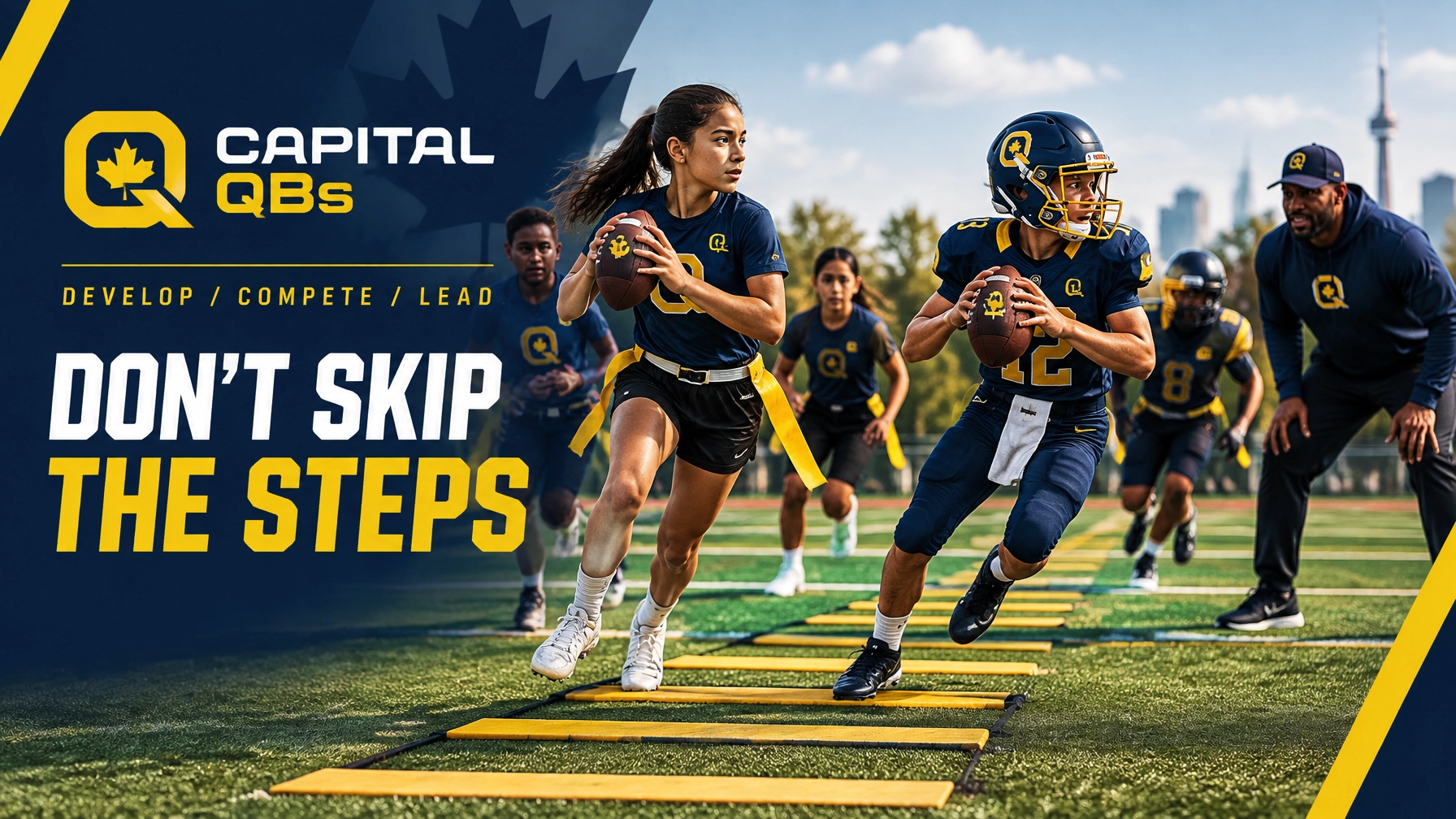
Leadership, Development and Climbing the Ladder the Right Way
Every young athlete wants to get better quickly.
They want to throw farther, run faster, make the starting lineup, become a leader and play at the next level. The problem begins when athletes try to skip parts of the development process because they are in a hurry to get ahead.
Think of your development like climbing a ladder.
If you are standing on the third step, you would not try to jump straight to the eighth. You would have skipped five important steps, and your chances of losing your balance and falling would be much greater.
Football development works the same way.
Whether you play flag football or tackle football, every skill builds on another:
Footwork supports throwing mechanics. Throwing mechanics support accuracy. Accuracy supports timing. Timing supports decision-making. Communication supports leadership.
You cannot rush the foundation.
Build Every Step
Young athletes sometimes want to work on the flashy parts of football before mastering the basics.
They want the deep ball before they can consistently throw the short pass. They want advanced reads before understanding defensive alignment. They want to be a captain before learning how to be a dependable teammate.
There is nothing wrong with dreaming big, but the best athletes respect the process.
Every practice, every correction and every repetition is another step on the ladder.
At Capital QBs, this progression connects directly to the L.E.A.D. Philosophy:
- Leadership: Inspire confidence and set standards.
- Extension of Plays: Improvise under pressure.
- Athleticism: Build endurance and perform under pressure.
- Decision Making: Apply tactical knowledge and intuition.
You do not develop these qualities by chasing only the most exciting drill. You build them through consistent work, one layer at a time.
The goal is not to get to the top quickly. The goal is to build yourself well enough that when you do get there, you are prepared to stay there.

The Development Ladder
Think about your quarterback development in this order:
- Footwork creates balance and body control.
- Throwing mechanics create a repeatable release.
- Accuracy allows you to place the ball where your teammate can make the play.
- Timing connects your footwork and release to the route.
- Decision-making helps you choose the right option under pressure.
- Leadership allows you to raise the standard for the entire offense.
⚠️ Do not confuse skipping ahead with progressing faster. If the lower steps are unstable, the higher steps will not hold.
The Bottom Line
The basics are not holding you back. They are carrying you forward.
Be a Leader, Not a Follower
Development is not only physical. It is mental too.
Leadership means learning how to think for yourself.
Do not make decisions simply because everyone else is doing something. Do not change who you are because teammates, friends or adults think there is only one way an athlete should act.
Beat to the sound of your own drum.
That does not mean being selfish. Great leaders put the team first. They respect the logo, support their teammates and understand their responsibilities.
They also have enough confidence to make good decisions when those decisions are not popular.
Leadership sometimes means being willing to say, “That’s not for me.”
For a quarterback, leadership is not about taking over the coach’s role. Your coach sets the team’s philosophy and standards. Your job is to become an on-field extension of that philosophy by communicating clearly, modelling preparation and helping your teammates stay connected to the plan.
A quarterback who inspires confidence does not need to make every moment about themself.
They show up prepared. They set the tempo. They respond well to mistakes. They encourage teammates. They do their job when nobody is applauding.
✓ Leadership Checklist
Before, during and after practice, ask yourself:
- Did I communicate clearly?
- Did I support my teammates?
- Did I respond well when something went wrong?
- Did my effort raise the standard?
- Did I put the team before attention?
The answers will tell you more about your leadership than a captain’s title.
It Is Okay to Ask Why
Being coachable does not mean you should never ask questions.
One of the best things a young athlete can learn to do is ask why.
But there is a right way and a wrong way to do it.
Do not ask, “Why are we doing this?” with an attitude because you do not feel like doing the drill.
Instead, ask:
“Coach, what are we trying to improve with this drill?”
That is a different question.
One challenges authority. The other shows curiosity.
Understanding why you are doing something makes you a smarter player. It helps you connect the drill to the game and understand the skill you are trying to develop.
A footwork drill may be improving your balance at the top of your drop. A throwing drill may be teaching you to create power with your lower body instead of forcing the ball with your arm. A decision-making exercise may be preparing you to identify coverage before the snap.
The question is not an excuse to avoid work.
It is a way to understand the work better.
Your coaches remain respected influencers in your development. Listen first. Work with purpose. Then ask thoughtful questions that help you learn.
Pro Tip
Curiosity makes you more coachable when it is combined with effort.
You Get Better at Practice
Games are exciting.
But games are not where most development happens.
Practice is where you get better.
Practice is where you fix footwork, improve throwing mechanics, learn routes, understand coverages and develop communication with teammates.
The game reveals how well you prepared.
That is why young athletes should never treat practice as something they have to get through before game day.
Practice is the work.
Game day is the test.
This applies to every quarterback, whether you are learning the rhythm of girls flag football, developing in tackle football or preparing for high school competition.
Your game performance is built through the quality of your repetitions.
One rushed repetition teaches rushed movement. One focused repetition gives you a chance to improve. Over time, those choices create habits.
Practice Should Be Hard
There is a phrase we believe strongly at Capital QBs:
Practice should be hard and challenging so games can be easy and fun.
That does not mean practice should be miserable.
It means practice should make you think. You should be challenged. You should make mistakes. Sometimes you should struggle with a drill before you understand it.
That struggle is part of development.
If practice is always easy, you are probably not pushing yourself enough.
The goal is to experience difficult situations in practice so they do not feel new during a game.
When the game speeds up and pressure increases, preparation gives you confidence.
This is where Extension of Plays, Athleticism and Decision Making become connected. You need the athletic ability to move under pressure, the awareness to keep the play alive and the decision-making skill to know when to throw, run or reset.
You do not build those qualities by avoiding difficult situations.
You build them in a controlled environment where you can make corrections and try again.
Stay patient always.

When Practice Is Working
Within Capacity
- You understand the purpose of the drill.
- You make mistakes and apply corrections.
- You stay engaged when the work becomes difficult.
- You finish each repetition with a clear focus.
- You leave with one improvement to carry forward.
Under Overload
- You rush through repetitions.
- You focus only on whether you “won” the drill.
- You stop listening after a mistake.
- You try to do everything at once.
- You become frustrated because progress is not immediate.
⚠️ Hard practice is not careless practice. Your coach should challenge you while keeping the work appropriate for your age, experience and physical readiness. Quality development includes preparation, recovery and attention to arm health.
Keep Climbing
Every athlete develops at a different pace.
Do not compare your ladder to somebody else’s. Focus on your next step.
Learn the skill in front of you. Listen to your coaches. Ask good questions. Practice with purpose. Be a great teammate. Take responsibility when you make mistakes.
Then move to the next step.
Leadership, character and athletic development are not built overnight.
They are built through hundreds of small decisions over time.
There is no shortcut.
If your current step is footwork, master footwork. If your current step is throwing mechanics, build a repeatable motion. If you are learning to read coverages, slow the process down until you understand what you are seeing. If you are becoming a leader, focus on how your preparation affects the people around you.
For quarterbacks ready to build the mental side of Canadian 12-man football, QBDT Quarterback Decision Training provides pre-snap read and decision-making practice through realistic coverage simulations. You can also learn more about QBDT registration and train the decision-making step with purpose.
Do not be in such a hurry to reach the top that you skip the steps that were supposed to prepare you for it.
Climb the ladder the right way.
One step at a time.
And earn every step along the way.
The Bottom Line
You do not need to become the finished quarterback today. You need to become better at the next step.
That is how you develop. That is how you build confidence. That is how you become the kind of teammate and leader your team can trust.
For families looking for structured quarterback development in Ottawa, explore the Capital QBs training calendar or learn more about Coach Ron Raymond and the Capital QBs approach.
- Capital QBs