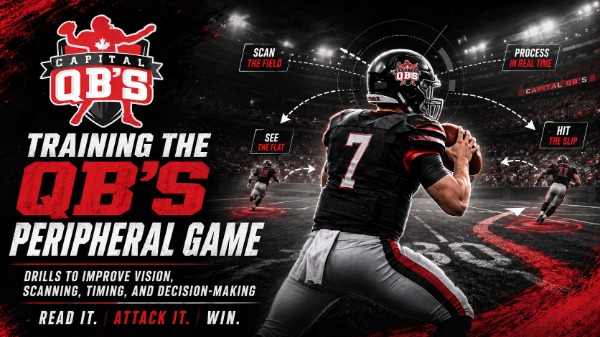
The modern quarterback is not just a passer anymore.
He is a processor.
In today’s game, especially with the rise of shotgun play-action, RPOs, slip routes, and second-level reads, the quarterback has to see the game differently. It is no longer just about staring down one defender and making a throw. The quarterback must learn how to feel movement, read space, and process defenders while on the move.
That is where the peripheral game comes in.
At Capital QB’s, we teach quarterbacks that their eyes are weapons. Your arm may get the attention, but your eyes make the offense dangerous.
The New Triple Option from Shotgun
The old triple option under center forced the quarterback to read defenders fast.
Read the dive key.
Read the pitch key.
Attack the edge.
Make the defense wrong.
The new version of that game is happening from the shotgun.
Now, instead of a fullback dive and pitch relationship, quarterbacks are reading defenders off play-action, while receivers slip into the flats. The quarterback may have to read a first-level defender, like an edge rusher or outside linebacker, or a second-level defender, like a linebacker or nickel player sitting in zone coverage.
The concept is simple:
Sell the run. Read the defender. Find the slip route. Attack the space.
But simple does not mean easy.
The quarterback has to keep his mechanics clean, carry out the play-action fake, reset his eyes, feel the pocket, and locate the defender without locking onto the route too early.
That is quarterbacking. That is football IQ. That is the difference between throwing the ball and playing the position.
Why Peripheral Vision Matters for Quarterbacks
A quarterback cannot stare at everything.
If you stare at the receiver, the defender drives on the route.
If you stare at the rush, you lose the coverage.
If you stare at the read key too long, the timing of the play dies.
The best quarterbacks do not see the field like a camera. They see it like a radar.
They keep their eyes disciplined, but they train their peripheral vision to pick up movement around them. They can feel a flat defender widen. They can see a linebacker freeze. They can sense man coverage chasing across the formation.
That is what we mean by the peripheral game.
It is not just vision. It is trained awareness.
What the QB Must Read
On shotgun play-action slip concepts, the quarterback must understand who is being stressed.
First-Level Read
This is often an edge defender, outside linebacker, or contain player.
The QB must ask:
Did he crash? Did he widen? Did he sit?
If the defender attacks the run action, the slip route may open quickly into the flat. If he widens with the slip route, the QB may need to reset inside or move to the next option.
Second-Level Read
This is often a linebacker, nickel defender, or hook/curl player.
The QB must ask:
Is he sitting in zone? Is he chasing man? Is he expanding to the flat?
If the second-level defender holds inside, the flat can become free money. If he widens, the QB must understand where the next window opens.
That is the chess match.
And the QB has to solve it in about two seconds. No pressure, kid. Just the whole offense depending on your eyes.
Drills to Build the QB’s Peripheral Game
These are the types of drills quarterbacks should be doing to develop better vision, processing, and reaction time.
1. Flash Read Drill
This drill trains the quarterback to keep his eyes forward while recognizing movement outside his direct line of sight.
How it works:
The QB takes a shotgun snap or simulated snap. As he carries out the play-action fake, a coach stands off to the side and flashes a color, number, or hand signal. The QB must complete his drop, identify the flash, and make the correct throw.
Coaching point:
The quarterback cannot turn his whole head early. He must learn to pick up information through his peripheral vision while staying mechanically sound.
What it teaches:
Awareness, calm eyes, and controlled processing.
2. Level 1 / Level 2 Read Drill
This drill teaches the quarterback to understand which defender controls the throw.
How it works:
Set up two defenders or coaches.
One represents the first-level read.
One represents the second-level read.
The QB executes play-action from shotgun. The first defender either crashes, widens, or sits. The second defender either expands to the flat or holds inside. The QB must identify the movement and throw to the correct receiver.
Coaching point:
The QB should not guess before the snap. He must confirm the defender’s movement after the fake.
What it teaches:
Read discipline and decision-making under timing pressure.
3. Slip Route Timing Drill
The slip route is only dangerous if the timing is right.
How it works:
Receivers align tight, winged, or reduced. On the snap, they sell block action or run action, then slip into the flat. The QB executes play-action, resets his feet, and delivers the ball on time.
Coaching point:
The ball should come out when the receiver clears into space, not after he has been standing there waving for three business days.
What it teaches:
Timing, trust, and route rhythm.
4. Peripheral Cone Scan Drill
This is a simple but powerful drill for training field awareness.
How it works:
Place cones or markers at different angles around the QB. Each cone has a number or color. The QB takes a drop while keeping his eyes downfield. A coach calls a number or points to a cone. The QB must identify it quickly, reset, and throw.
Coaching point:
The quarterback should keep his base balanced. No panic feet. No drifting. Eyes and feet must work together.
What it teaches:
Peripheral recognition while maintaining throwing posture.
5. Zone or Man Recognition Drill
Slip routes change based on coverage.
How it works:
Use one receiver and one defender. The defender either sits in zone or follows in man coverage. The QB executes play-action and must decide whether the slip route is available.
If the defender sits inside, throw the flat.
If the defender widens or chases, reset to the next read.
Coaching point:
The QB must learn the difference between open now and open soon. Young quarterbacks often throw late because they wait until the receiver is visibly wide open.
What it teaches:
Coverage recognition and anticipation.
6. Moving Pocket Read Drill
A lot of these throws happen with the QB moving.
How it works:
The QB executes play-action and rolls slightly left or right. A receiver slips into the flat while a defender reacts. The QB must keep his shoulders controlled, scan the read key, and deliver accurately on the move.
Coaching point:
Do not let the quarterback turn into a full sprint unless the concept requires it. Controlled movement is better than panic movement.
What it teaches:
Vision, body control, and throwing accuracy while moving.
7. Two-Option Reaction Drill
This drill forces the QB to process fast without predetermining the throw.
How it works:
Give the quarterback two options: a slip route into the flat and an inside route behind it. The defender chooses which route to take away after the snap. The QB must read, react, and throw.
Coaching point:
The QB should not be robotic. He must understand spacing. If the flat defender widens, the inside window may open. If the defender sits inside, the flat is there.
What it teaches:
Decision-making, spacing, and controlled aggression.
The Big Coaching Point: Eyes Before Arm
Most young quarterbacks want to prove they can throw.
That is great.
But the next level is proving you can see.
The quarterback who understands where defenders are moving will always play faster than the quarterback who only relies on arm talent.
The new shotgun triple option is not just a trick play. It is a way to put defenders in conflict. When the QB understands the read, the offense gains answers.
If the defender crashes, throw behind him.
If he widens, attack inside.
If he sits, make him wrong with timing.
If he chases in man, use space.
If he freezes, take the free yards.
That is the game.
Final Word for Quarterbacks
Your peripheral game does not improve by accident.
You have to train it.
Every rep should have a purpose. Every play-action fake should look real. Every slip route should have timing. Every read should force your eyes to work.
At Capital QB’s, we do not just train quarterbacks to throw the football.
We train them to read it, attack it, and win it.
Because once your eyes catch up to your arm, the game starts to slow down.
And when the game slows down for the quarterback, it gets real uncomfortable for the defense.