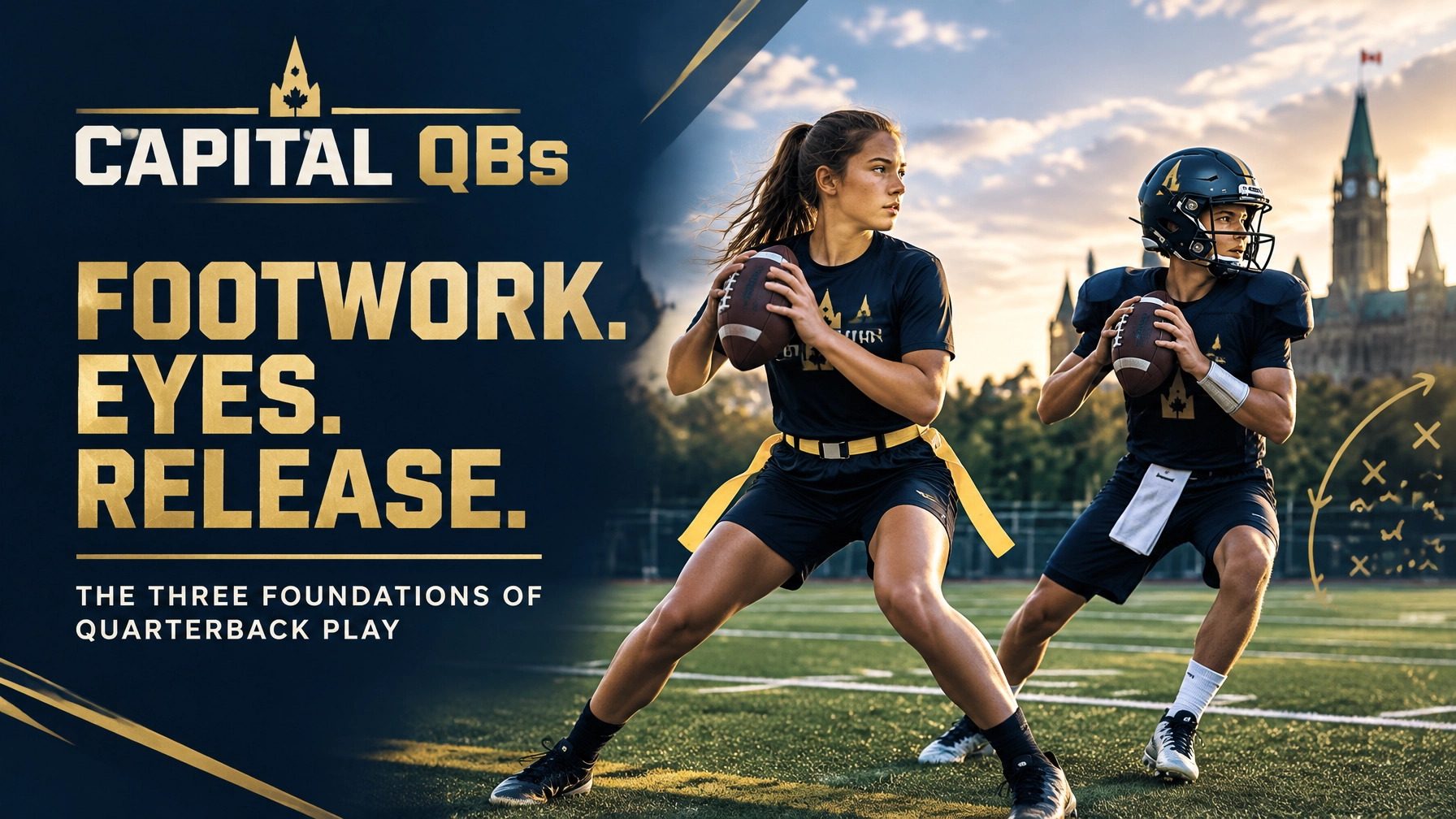
Quarterback development can get complicated quickly. Coaches talk about arm strength, mechanics, accuracy, coverage recognition, timing, leadership, mobility and football IQ. All of those things matter.
But almost every throw comes back to three connected foundations:
FOOTWORK. EYES. RELEASE.
Your feet must match the concept. Your eyes must gather and process information. Your release must deliver the football on time.
If one breaks down, the entire play can break down with it. Throwing is not simply an arm action. It is a complete process:
See it. Move correctly. Deliver it.
1. FOOTWORK: YOUR FEET MUST MATCH THE ROUTE
Quarterback footwork should never be random. Every step has a purpose, and every concept has a rhythm.
Your feet work with the receiver’s route. Quick-game routes demand quick, efficient footwork. Intermediate concepts need controlled depth and timing. Rollouts require movement that creates space while preserving a usable throwing platform.
You and your receiver are operating on the same clock. Communicate with your receiver and offensive coordinator so you understand the concept, route depth and expected timing. Then execute the footwork within your offense’s system.
QUICK GAME
On quick-game concepts, the ball needs to come out quickly. Secure the snap, organize your base, confirm the read and deliver on time.
A hitch, speed out, slant or quick access throw does not need a long drop. Wasted movement makes the throw late. If your receiver is ready and your feet are still moving, the timing is already off.
INTERMEDIATE THROWS
Intermediate concepts often need more patience. A three-step rhythm can help create the timing for a receiver to reach the right depth.
Know where the receiver is going, how deep the route is, when the break should happen and when your feet should finish. Your platform should be ready as the route reaches its decision point.
Quarterback timing is not simply “One. Two. Three. Throw.”
It is “One. Two. Three. Read. Confirm. Deliver.”
ROLLOUTS
On a rollout, you are moving while staying connected to the receiver. Create space from pressure, control your shoulders and hips, keep your vision downfield and establish the best available throwing platform.
Do not run toward the sideline and hope a receiver comes open. Move with a purpose, understand the route depth and know when to slow down. This is where Athleticism and Extension of Plays support one another: you use movement to create an opportunity without losing the ability to make a sound decision.

The Rule: Your feet should tell the same story as the route. Quick route, quick feet. Intermediate route, controlled depth and rhythm. Rollout, purposeful movement.
The Bottom Line: When your feet and the route are connected, you give yourself a better chance to deliver the ball accurately and on time.
2. EYES: TAKE THE PRE-SNAP PICTURE
Good quarterback decisions begin before the snap. We call this taking the pre-snap picture.
Scan the defense and ask:
- How many defenders are in the box?
- Where are the safeties?
- Are the corners playing press or off?
- Where is the leverage?
- Where might pressure come from?
- Is there a matchup or defensive look you recognize?
Think of it like taking a photograph. You use the information in front of you, along with film study, practice, coaching and experience, to form an initial read. In 12-man Canadian football, the defensive picture can include several moving parts. The specific cues will differ by formation, play and league rules, but the job stays the same: notice useful information before the snap.
That is where Decision Making begins.
CONSCIOUS AND SUBCONSCIOUS PROCESSING
Young quarterbacks can feel like they have to consciously think through every detail after the snap. That is too much to process at game speed.
At first, you may tell yourself: “The safety is down. The corner is off. The linebacker is inside.” With purposeful repetitions, you start recognizing familiar patterns more quickly. Your brain builds a library of defensive pictures, much like learning to recognize familiar roads on the way home.
Film study, classroom work and practice repetitions all help build that library. The goal is not to guess. It is to recognize a picture, make a plan and stay ready to adjust.
ACTIVE EYES AFTER THE SNAP
The pre-snap picture is a starting point, not a promise. After the snap, confirm what you saw. A safety may rotate, a linebacker may drop, a corner may squat or a defender may blitz.
Ask: Did the defense do what I expected?
Do not stare at one receiver and hope they get open. See the defense, track leverage and recognize where the throwing window is developing. Your eyes help your brain make the decision; your feet prepare your body to act on it.

The Bottom Line: Take a pre-snap picture, then confirm it after the snap. If the defense changes the picture, be ready to adjust.
3. RELEASE: HOW FAST CAN YOU GET THE BALL OUT?
A quick release is not just a quick arm. It starts before the arm moves. The football begins in two hands, and every part of the motion should help you deliver it efficiently.
TWO-HAND SEPARATION
How efficiently do your hands separate? Pull the football cleanly into throwing position. Avoid extra movement that adds time.
THE DRAW
How directly does the ball travel from its ready position into the throwing motion? A long, looping draw takes time, and defenders are closing space while that happens.
ARM ACTION
Use a compact, repeatable motion. Avoid unnecessary movement or forcing the arm to manufacture velocity. Your body has helped create the platform; the arm completes the delivery. Do not chase arm speed at the expense of balance, accuracy or a comfortable throwing motion.
WRIST FLICK
The wrist helps finish the throw and influence the ball’s rotation, direction and touch. Let the football come off your hand cleanly rather than forcing an exaggerated finish.
The release completes the decision: you have seen the picture, moved your feet and chosen where to go with the ball. Now deliver it.

Pro Tip: If the ball is consistently late, do not assume the arm is the only problem. Check the whole sequence: eyes, decision, footwork and release.
THE COMPLETE SEQUENCE
This is why I keep coming back to FOOTWORK. EYES. RELEASE.
- Footwork gets you into position.
- Eyes gather and process information.
- Release delivers the decision.
Think about the sequence:
Pre-snap picture
↓
Eyes confirm the defense
↓
Feet match the route
↓
Brain makes the decision
↓
Hands separate
↓
Ball enters the draw
↓
Arm accelerates
↓
Wrist finishes
↓
BALL OUT.
That is quarterback play: connected actions, not isolated mechanics.
SPEED COMES FROM EFFICIENCY
Playing faster does not mean moving your arm faster at all costs. It means eliminating unnecessary time throughout the process.
Slow eyes create slow decisions. Poor footwork disrupts timing. An inefficient release delays the throw. When those areas improve together, you can play faster without playing frantic.
The Bottom Line: Efficient quarterbacks are prepared to see, move and deliver. They do not rush just to look fast.
TRAIN THE PROCESS
Do not go to the field simply to throw 200 footballs. Give every repetition a purpose.
Ask yourself:
- Why am I taking these steps?
- What am I looking at?
- When should the ball come out?
Throwing sessions matter. But throwing without an understanding of timing, vision and movement can reinforce habits that do not hold up under pressure.
Make practice challenging. Add route timing, changing defensive pictures and controlled pressure as your skills develop. Practice should be hard so games can feel easier and more fun. That is how you train the process, not just the throw.
For more on why purposeful repetitions matter, read Practice Is the Ultimate Forge for Elite Players.
THE CAPITAL QB’S STANDARD
Every quarterback has a different body, arm and development pace. Every quarterback can improve these three areas:
- FOOTWORK: Make your feet match the route.
- EYES: Take the pre-snap picture and stay active after the snap.
- RELEASE: Make the draw efficient and deliver the ball on time.
When those foundations work together, the ball comes out sooner, receivers get it on time and you can recognize pressure earlier. Decision-making and confidence grow because the game becomes easier to read.
At Capital QBs, we develop the complete position through the L.E.A.D. Philosophy: Leadership, Inspire confidence and set standards; Extension of Plays, Improvise under pressure; Athleticism, Build endurance and perform under pressure; Decision Making, Apply tactical knowledge and intuition. Footwork, eyes and release help bring those qualities onto the field.
If you are looking for a purposeful next step, explore Capital QBs’ 2027 training options for winter and spring development for boys and girls in flag and tackle football.
FOOTWORK. EYES. RELEASE. — SEE IT. SET IT. SEND IT. — Train the position, not just the arm.