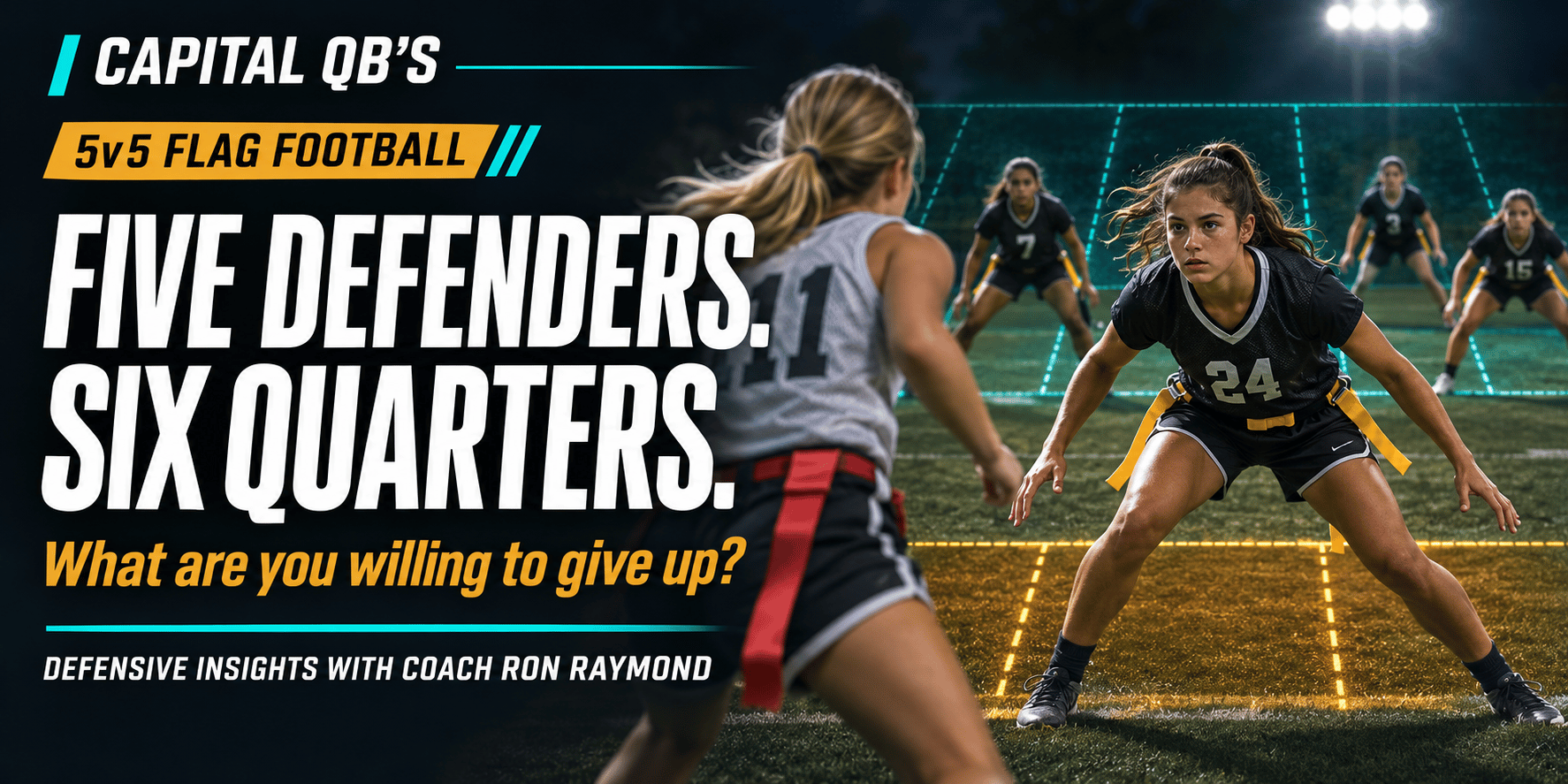
This article by Coach Ron Raymond covers 5v5 flag football for girls flag football.
You can’t cover everything in 5v5 flag football.
Every defensive call involves a choice about what to protect in girls flag football.
It also involves what you’re willing to allow.
“You can’t cover everything, and down and distance dictates the coverage and assignments.” — Coach Ron Raymond
The goal is to make that choice before the snap—and make sure all five defenders understand it.
Seeing the Field in Six Quarters
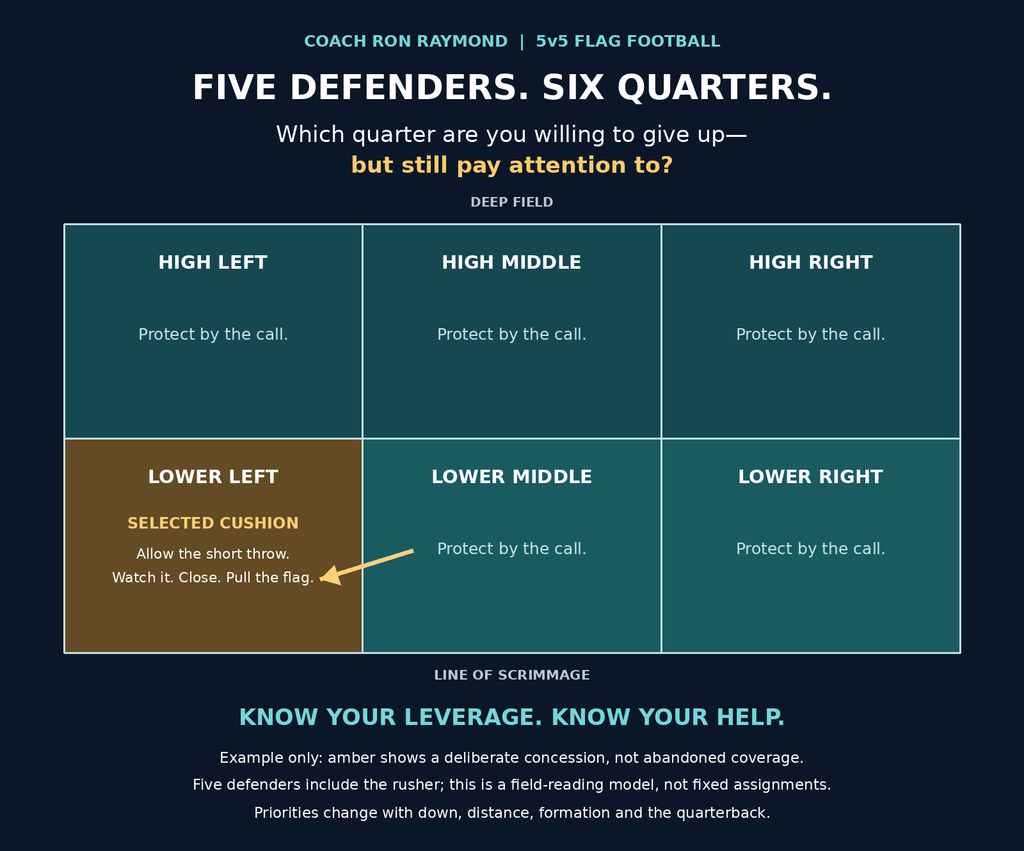
Coach Ron sees the field in six areas he calls “quarters”: three lower quarters and three high quarters.
The lower quarters divide the underneath field into left, middle and right. The high quarters divide the deeper field the same way.
With only five defenders available, the question becomes:
“Which quarter are you willing to give up but still pay attention to?” — Coach Ron Raymond
Girls Flag Football
This is a way to teach players how to see space and threats. It does not mean assigning one defender to each box. Defenders must respond to routes moving between areas, and committing a rusher leaves four players in coverage.
Giving up an area means accepting a calculated opportunity for the offense while remaining ready to respond.
On long yardage, that might mean allowing a short outside completion, then closing immediately for the flag. You’re conceding the catch with a plan to control the gain.
The highlighted quarter in the graphic is one example. The area you concede changes with the situation.
Down and Distance Gives the Space Its Value
A three-yard catch means something different when the offense needs two yards than when it needs fifteen.
On long yardage, defenders can prioritize deeper threats and rally to underneath throws. On short yardage, they may need to tighten the immediate passing windows while preserving responsibility for a deep shot.
Near the goal line, the available space compresses again.
Before calling the defense, ask:
Which quarter can hurt us most?
Which completion can we afford?
Who closes if the quarterback takes that throw?
Where is the help if the offense attacks our priority area?
A concession only works if the defense finishes the play. A short catch followed by three missed flag pulls defeats the purpose.
The Big Two: Leverage and Help
“Leverage and where is your help—that is the big two rules of thumb on defense.” — Coach Ron Raymond
Leverage is how a defender positions herself to make a particular release, route or throwing window more difficult.
That positioning should connect to her help.
With reliable help inside, a defender can position herself to make the outside release harder and influence the receiver toward support. With help outside, her approach changes. With no defender behind her, she must respect the threat of getting beaten deep.
In the six-quarter picture, players should recognize both their immediate threat and the support around it.
Knowing your help also means understanding what that teammate is already responsible for. A safety facing two vertical routes cannot automatically rescue every underneath defender.
Under Center Should Trigger an Alert
Coach Ron treats an under-center quarterback as a strong alert for a handoff, quick pass or play action.
His response:
“I would bring down at least one linebacker or defender to catch the ball carrier’s flag.”
That adjustment puts a defender closer to the immediate action. She needs a clear read, a controlled pursuit angle and a dependable flag pull.
The rest of the defense must account for the space she leaves. If a defender steps down from a lower quarter, who responds to a receiver entering behind her?
Play action makes that question essential. One defender reacting downhill should not bring the entire defense with her.
Disrupt and Reroute to Affect Timing
“The longer you can disrupt and reroute the receiver, the more time your rusher has to get to the QB.” — Coach Ron Raymond
Teach this through legal positioning, leverage and movement within your competition’s rules. Disruption must not become holding, pushing or prohibited contact.
Making a receiver adjust her path can affect when she reaches the intended throwing window. That delay can force the quarterback to hesitate, giving the rusher more time.
But defenders must preserve their responsibilities. Following one receiver across several quarters without a planned exchange can open space for another.
Practice should connect route recognition, communication and pressure so players understand how their actions support one another.
Make Every Concession a Team Decision
A defensive call should give players a shared purpose:
“They need twelve. Protect the deeper quarters. We can allow the short outside throw. Close together and finish the flag pull.”
That is something players can recognize and execute.
Coach Ron’s six-quarter approach gives the defense a common picture of the field. Down and distance establishes the priorities. Leverage influences the route. Help connects the defenders. Pressure limits the quarterback’s time.
The question remains the same before every snap:
“Which quarter are you willing to give up but still pay attention to?”
RonFounder
Capital QB’s was founded in June 2011 by 8-time champion Head Coach Ron Raymond of Ottawa, Ontario.
The game of football has been constantly evolving, leading to an increasing complexity in defensive schemes. For a quarterback, understanding these schemes, […]
Quarterback development can get complicated quickly. Coaches talk about arm strength, mechanics, accuracy, coverage recognition, timing, leadership, mobility and football IQ. All […]
Contains information related to marketing campaigns of the user. These are shared with Google AdWords / Google Ads when the Google Ads and Google Analytics accounts are linked together.
90 days
__utma
ID used to identify users and sessions
2 years after last activity
__utmt
Used to monitor number of Google Analytics server requests
10 minutes
__utmb
Used to distinguish new sessions and visits. This cookie is set when the GA.js javascript library is loaded and there is no existing __utmb cookie. The cookie is updated every time data is sent to the Google Analytics server.
30 minutes after last activity
__utmc
Used only with old Urchin versions of Google Analytics and not with GA.js. Was used to distinguish between new sessions and visits at the end of a session.
End of session (browser)
__utmz
Contains information about the traffic source or campaign that directed user to the website. The cookie is set when the GA.js javascript is loaded and updated when data is sent to the Google Anaytics server
6 months after last activity
__utmv
Contains custom information set by the web developer via the _setCustomVar method in Google Analytics. This cookie is updated every time new data is sent to the Google Analytics server.
2 years after last activity
__utmx
Used to determine whether a user is included in an A / B or Multivariate test.
18 months
_ga
ID used to identify users
2 years
_gali
Used by Google Analytics to determine which links on a page are being clicked
30 seconds
_ga_
ID used to identify users
2 years
_gid
ID used to identify users for 24 hours after last activity
24 hours
_gat
Used to monitor number of Google Analytics server requests when using Google Tag Manager
1 minute
Marketing cookies are used to follow visitors to websites. The intention is to show ads that are relevant and engaging to the individual user.
A video-sharing platform for users to upload, view, and share videos across various genres and topics.
Registers a unique ID on mobile devices to enable tracking based on geographical GPS location.
1 day
VISITOR_INFO1_LIVE
Tries to estimate the users' bandwidth on pages with integrated YouTube videos. Also used for marketing
179 days
PREF
This cookie stores your preferences and other information, in particular preferred language, how many search results you wish to be shown on your page, and whether or not you wish to have Google’s SafeSearch filter turned on.
10 years from set/ update
YSC
Registers a unique ID to keep statistics of what videos from YouTube the user has seen.
Session
DEVICE_INFO
Used to detect if the visitor has accepted the marketing category in the cookie banner. This cookie is necessary for GDPR-compliance of the website.
179 days
LOGIN_INFO
This cookie is used to play YouTube videos embedded on the website.